How to Create a Product Catalog in 2026?
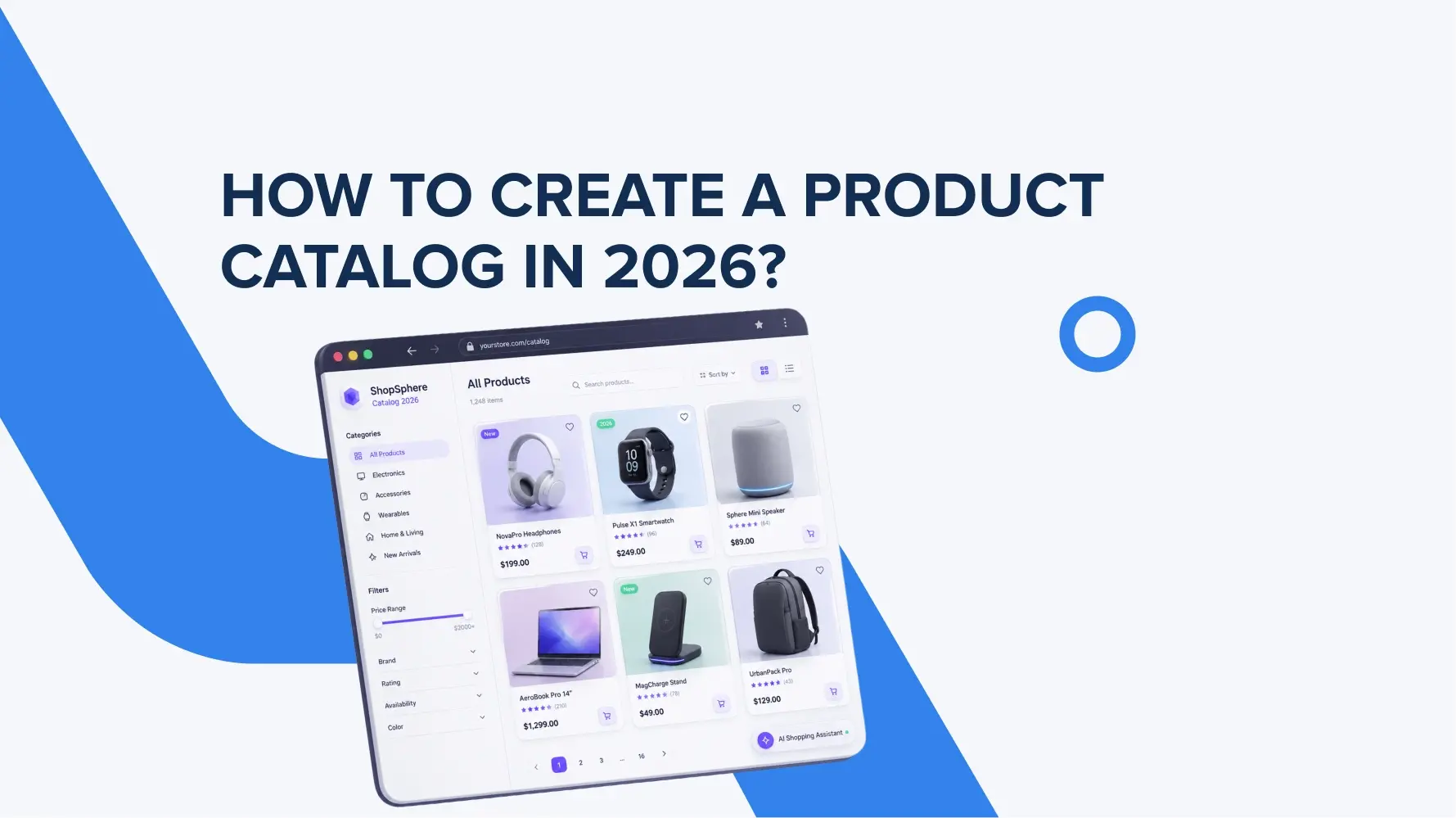
How to make a product catalog in 2026
Product catalog creation starts not from the item listings on the marketplace. The process itself goes deeper, at the architecture level, where teams create a flexible data structure that scales easily and integrates with various sales channels.
Then, set up a unified system of product attributes to ensure accurate search, filtering, and personalization. Next, the product catalogue should work as part of the bigger ecosystem (CRM & ERP integrations, and real-time analytics). The development team connects these tools into one organized system.
The last but no less important step is quality content for the product catalog items. All pictures, descriptions, texts, and other visuals must clearly tell what the specific item is about and align with the SEO requirements. It should also be easy for content managers to update and edit content without the development team’s involvement.
What should a product catalog include?
A modern product catalog should include not only standard product information on every item but structured data as well. Namely:
– Unique SKUs and product identifiers.
– Product names, descriptions, and categories.
– Structured product attributes (size, color, material, brand, etc.).
– Product variants and configurations.
– High-quality images, videos, and other media.
– Pricing, promotions, and inventory availability.
– Advanced search and filtering.
– Personalized product recommendations.
– Customer reviews and ratings.
– Integration with CRM, ERP, PIM, and e-commerce systems.
– Multi-language, multi-currency, and multi-region support.
– Analytics for searches, page views, and sales performance.
– Automatic product data synchronization.
– SEO-friendly product pages.
How should products be structured and categorized?
All the items must be organized in a clear hierarchy within the product catalog management systems. With this, customers can find items they are looking for faster, and the benefit from the business side – easier catalog scaling.
The catalog management structure based on categories and subcategories applies to all the item sets. They have a unique identifier (SKU), a single set of attributes, and logical relationships with related products. This structure simplifies search, filtering, personalization, analytics, and integration with business systems such as CRM, ERP, PIM, and marketplaces.
What content and metadata must be in 2026?
In 2026, structured metadata matters most as they provide fast search, personalization, and AI-driven functionality performance. Every item in the catalog should have its own detailed attributes, SEO metadata, high-quality images and videos, and information about variants, availability, price, and specifications. Specifically, this data influences the customer decision to learn more about the item and then buy it.
Once all product metadata is in place, it’s important to create structured Schema.org data, tags, information on compatibility, relationships with other products, as well as data required for AI-powered search, recommendations, and multichannel sales.
Keep this consistency across all sales channels, and conversions go up much faster.
Conclusion
An effective product catalog in 2026 is a scalable data system helping businesses manage products faster while supporting AI, personalization, system integrations, and multichannel growth. The development process is better to start on the architecture side, then steadily move to feature development to make product discovery faster and easier for customers.