Sleek Solutions: Transforming CRM with AI-Driven UX/UI Design


Why implement AI-powered UX/UI design in your CRM system?
As a business owner, you undoubtedly understand the importance of developing and expanding your business. Anything that remains stagnant is likely to struggle, especially in the long run.
When newly created businesses begin to gain momentum, occupy their niche in the market, and increase their customer base, they often do so without a CRM system. Instead, they turn to alternatives such as Google Spreadsheets and Microsoft Excel to organize customer data, manage sales, and run their operations.
However, as the business grows along with its customer base, having a CRM system becomes inevitable. No other alternative can effectively handle these challenges as your business scales.
In this light, you may think about the design of your CRM system, whether you already have one or are just planning to build one from scratch. You can start small and create a custom design that suits your business needs. Or you can take it one step further and leverage the power of artificial intelligence in your UX/UI design—a trend that has already demonstrated its effectiveness in industries ranging from tourism and healthcare to hospitality and education.
How can AI improve the UX/UI design of your CRM system?
Now let’s look at how using artificial intelligence to design your CRM system can bring positive changes to your business:
It personalizes user experience. Artificial intelligence uses algorithms to collect user data and analyze their behavior, creating a truly unique experience for your customers. It offers recommendations based on your customers’ needs and wants, and updates your CRM system’s interface with the relevant content in real-time.
It automates design process. With the help of artificial intelligence tools, you can improve the efficiency of the entire design process, making it faster without sacrificing a single detail. This includes generating design mockups for your CRM, creating color palettes, customizing design elements for different devices, and more.
It improves usability. Artificial intelligence in your CRM design ensures consistency with your brand in interface, layout, and navigation. In addition, machine learning algorithms allow you to analyze customer feedback and improve various design elements.

What are the challenges of integrating AI into the UX/UI design of your CRM?
Creating a custom design for your CRM system can be a daunting task full of challenges, especially when integrating AI into UX/UI design. Below we look at these challenges and how experienced software development teams solve them:
Lack of experience with AI. Since using artificial intelligence in the context of UX/UI design is a comparatively new trend, some designers may lack enough expert experience in using it. If this is the case, then all the potential benefits of this powerful technology could jeopardize the whole deal.
At TRIARE, we not only keep our finger on the pulse of all the new trends in software development and UX/UI design, but also make sure that we are qualified to use them. Our designers are constantly learning and upgrading their skills to know how to use artificial intelligence to make the most of solutions, including CRM systems.
Over-reliance on AI. Some may think that artificial intelligence can replace an expert designer, but that’s not how things work. AI is not a magical wand, it is a tool that can enhance your CRM system in the hands of experienced UX/UI designers.
Both business owners and designers need to maintain a balance between the use of artificial intelligence and human touch. The TRIARE design team skillfully uses artificial intelligence tools to speed up design tasks while ensuring that the final product is true to your brand, always leaving room for critical thinking.
Technical complexity. Another hurdle when using AI-driven design for CRM systems is providing transparency and clarity to their owners. As AI systems become increasingly complex, designers must explain how these algorithms make decisions, allowing business owners to understand and even question the impact of AI on their experience.
If you’re designing a CRM system with TRIARE, you can trust that our designers will explain the role of AI in your solution and exactly how it works, keeping you in control throughout the design process.
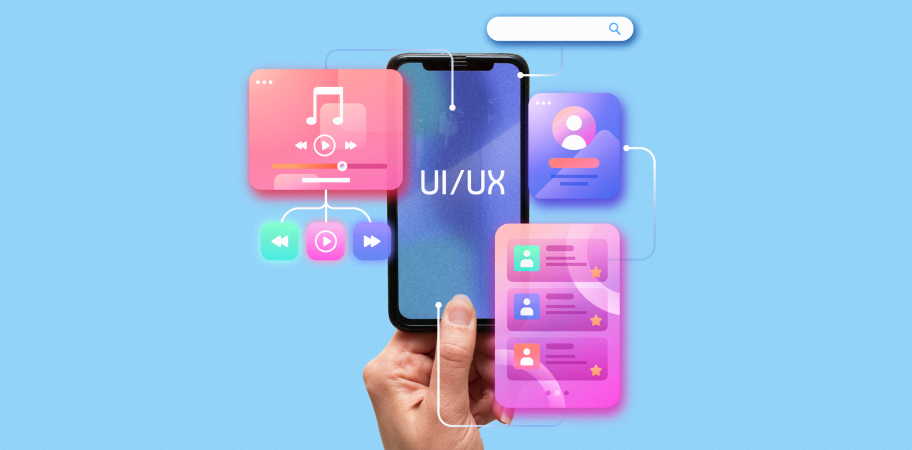
How does AI-driven UX/UI design enhance user experience?
We are not exaggerating when we say that intelligence has sparked a revolution in UX/UI design. Let’s take a look at why business owners are fascinated by this transformative technology:
It puts the user first. AI-based UX/UI design is created to understand the needs, preferences, and behaviors of users. It provides insight into custom patterns, allowing designers to tailor CRM interfaces specifically for their target audience.
It generates content. UX/UI designers often rely on AI for content generation. From choosing colors to automatically generating visuals, AI-powered design increases engagement and makes CRM system designs appealing to users.
It eliminates pain points. Using machine learning, AI-powered UX/UI design identifies and addresses design pain points. It anticipates potential issues that users may encounter in the CMS and proactively suggests solutions, such as guiding users through complex processes.
It detects scams. AI-driven security measures protect user data to ensure a safe online experience. It detects unusual user activity inside the CMS and protects against fraud and unauthorized access, providing a reliable and secure user experience.
How does AI-powered UX/UI design improve customer relationships?
Creating a seamless user experience is not the only thing that artificial intelligence combined with custom UX/UI design can do for your customers. Here are some more benefits:
24/7 customer care. With AI-powered UX/UI design, you can provide customer support regardless of time zones and business hours. Virtual assistants and chatbots powered by artificial intelligence algorithms are available 24/7 to answer customer queries, provide assistance, and resolve issues quickly.
Human-like language. AI virtual assistants interact with customers using natural language processing (NLP) techniques to create human-like communication. Using language that feels familiar and empathetic, AI-powered UX/UI design helps build trust with customers, strengthening the relationship between a brand and its audience.
Accessibility. With voice commands, screen readers, and language translation capabilities, AI-powered interfaces accommodate users with disabilities or language barriers, ensuring equal access to products and services. By prioritizing inclusivity, you demonstrate commitment to serving all customers, regardless of their circumstances.
What are the business benefits of using AI when developing a CRM system?
Above, you learned that using AI for CRM systems can improve user experience and customer relationships, but it can bring more benefits to your business:
Insights into customer behavior. AI tools such as heatmaps and session recordings offer invaluable insight into customer behavior. They give a complete picture of what pages and information are of interest, and also identify the barriers that cause them to leave the site. Understanding how customers interact with your website is critical to improving navigation and ensuring a smooth transition from landing page to conversion.
Efficient lead management. AI is often used to analyze broad statistical data such as demographics and interaction history. It helps sales teams identify the most promising leads and accurately move customers through the sales funnel. This strategic approach ensures that your focus is on high-potential leads, maximizing the efficiency and effectiveness of your business.
User feedback collection. AI-powered CRM systems typically include built-in features designed to make it easier to collect customer feedback. Through surveys, email interactions, and social media monitoring, business owners can quickly and effectively gather information about customer perceptions of their website.
What are the emerging AI technologies in UI/UX design?
AI technologies do not stay still, they develop offering business owners more valuable opportunities to streamline various processes and enhance the look of web and app solutions. Let’s see what are the latest emerging AI technologies in UX/UI design and potential benefits you can get from them.
Generative AI. UX/UI designers find generative AI invaluable for creating visually stunning solutions, and business owners especially value its ability to resonate with target audiences.
Generative AI runs on complex algorithms that auto-generate multiple design elements, allowing you to experiment with different styles, layouts, and features. This approach allows businesses to stay on top of new design trends and infuse their solutions with cutting-edge creative concepts.
Moreover, generative AI plays a key role in optimizing website performance across different devices. Whether visitors access a site from desktops, laptops, tablets, or smartphones, AI ensures a smooth user experience with fast loading times, thereby improving accessibility and increasing user satisfaction.
Emotional AI. As the name suggests, this modern technology improves UX/UI design by honing the emotions of users. It analyzes their facial expressions and tone of voice to gauge their mood, and then customizes the website’s appearance accordingly.
When users feel confused or stressed, the emotional AI shows empathy and adjusts color tones to match their vibe. This personalized approach strengthens the connection between the user and the interface.
But with great innovation comes great responsibility. The rise of emotional AI raises ethical and privacy concerns. As these systems become better at understanding and influencing human emotions, we must address issues of consent, manipulation, and bias. Developers and designers must address these issues, ensuring that emotional AI is used ethically and transparently for the common good.

TRIARE cases on improving UX/UI design in CRM systems
TRIARE boasts extensive experience in improving the UX/UI design of CRM systems. Let us illustrate this with two case studies:
- Info Reach. A client specializing in B2B solutions for financial institutions already had a functioning system, but turned to us for help in optimizing its interface.
Through thorough research and understanding of the client’s business and industry standards, we have proposed functional enhancements along with UI/UX enhancements. This holistic approach was aimed not only at improving the interface, but also at increasing the competitiveness of the system in the market.
Our collaboration resulted in a new UX design, proposed functional improvements, and documented user flows, providing the client with a sophisticated CRM system ready to succeed in a competitive environment.
- Indigo. The client approached TRIARE with a legacy CRM platform dating back to 2006, laden with accumulated functionalities that rendered it convoluted and unwieldy. Our mission was clear: streamline the system, infuse it with contemporary features, and craft a user-friendly interface.
Key features such as an improved dashboard, automatic report generation, and a subscription widget were prioritized to optimize user workflow and efficiency.
As a result we created a proven system redesigned for the demands of today’s world. Indigo now boasts a sleek interface, intuitive navigation, and enhanced features, empowering users to unleash their sales genius with ease.
Conclusion
Integrating AI-powered UX/UI design into CRM systems offers many benefits, from personalized user experiences to streamlined design processes and improved customer relationships. Still, collaboration with experienced software development and design teams is critical to success.
If you need help creating a modern design for your CRM system, don’t hesitate to contact us. TRIARE team of experienced software developers and designers will be happy to assist you in creating an attractive and user-friendly UX/UI design for your CRM experience.