How to Build an MVP with AI: A Step-By-Step Guide
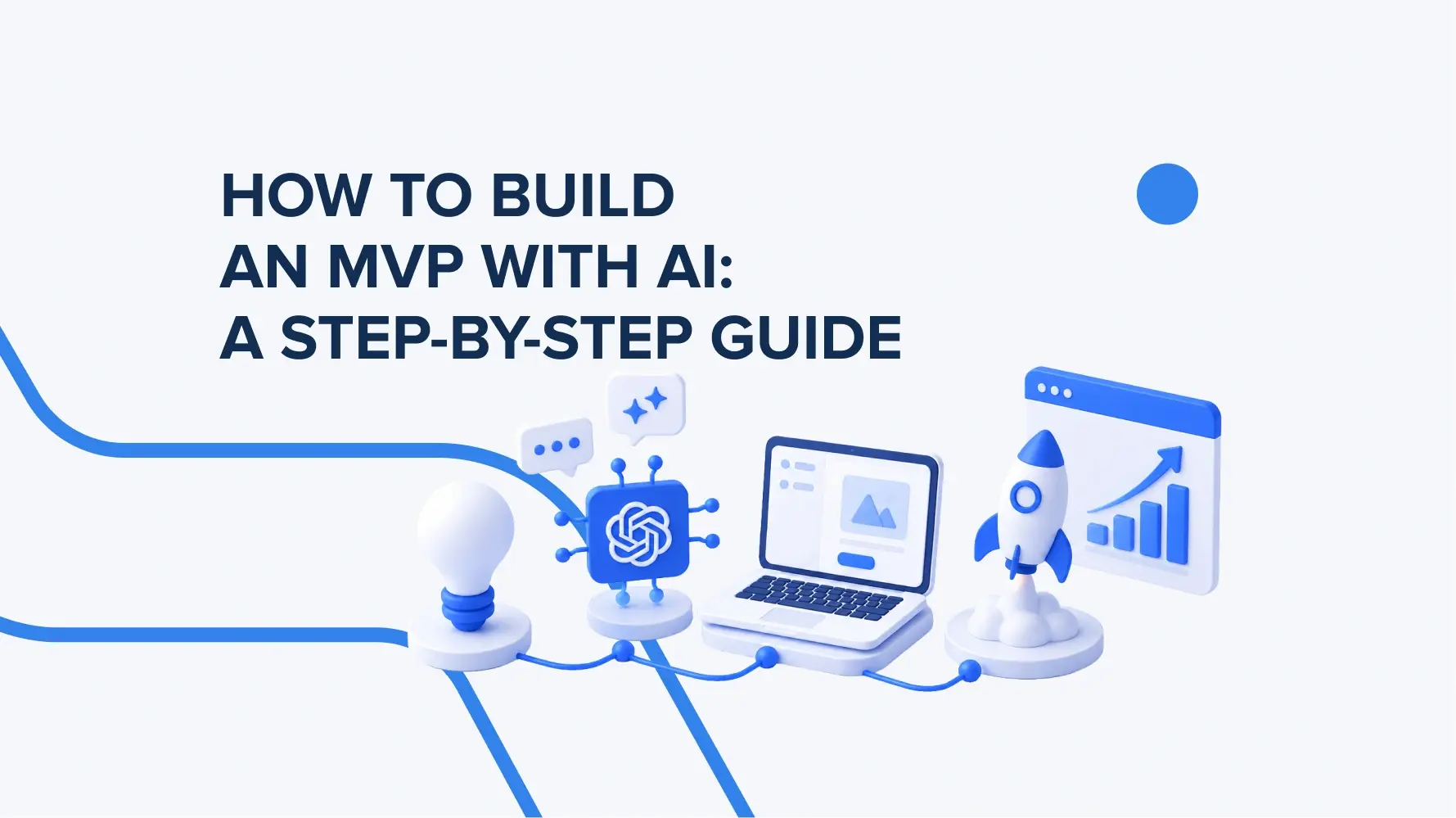
How to build an MVP with AI: A step-by-step guide.
MVP development with AI starts with identifying what concrete business problem it should solve. On the other hand, there must be a product idea that the company wants to test for viability. Having these in hand, the team can start the development process.
Based on the product idea and primary goals, the minimal feature set is defined. After this, the team selects specific AI technologies and integrates them into the MVP. After launch, they collect feedback from early users and analyze the results that can direct further development in the right way. Then comes the testing and improving stage, to create a product that meets users’ expectations and business goals.
Remember that AI helps teams build MVPs faster, but the best results come from custom development driven by AI tools. It supports development, do not replace the development team.
What does it mean to build an MVP with AI?
Building an MVP with AI means visualizing your idea with the help of specific AI tools and integrated features. The final product you get helps you understand whether there is a demand for it, if people are more likely to use it, and how well integrated features solve users’ issues or cover their needs. That’s the core point.
From the technical side, building an MVP with AI means creating a brand new product where the key role plays AI, integrated into the product’s workflows. Unlike a traditional MVP, an AI MVP focuses not only on basic functionality, but also on evaluating how effectively AI solves a specific task. For example, automating a process, generating content, analyzing data, or providing personalized recommendations.
We used this approach while building the Pantoh app, where we implemented AI features for recipe import and a personal sous chef option. With them, users can instantly add recipes from text or links, streamlining the cooking journey from discovery to preparation. Implemented features also complement recipes with smart guidance and ingredient substitutions, helping users easily manage both ingredients and allergens, making cooking simpler, safer, and more enjoyable.
Step 1. Validate the idea and define the MVP scope
Before kicking things off, make sure that your product idea solves real people’s problems and can find its audience quickly. At this stage, the team, together with the product owner, defines the core business hypothesis and the target audience. Based on this, it’s possible to create a list of minimum set of features needed to test it. And obviously, all depends on the product type and industry.
When you have a clearly defined scope, you can avoid unnecessary features, reduce costs, and get results faster.
Step 2. Use AI tools for research, requirements, and wireframes
AI tools replace all the manual work the teams did before. It significantly speeds things up and drives smarter research and development. First, AI helps analyze the market and competitors, organize requirements, create user stories, produce technical documentation, and even propose initial versions of wireframes or UX concepts. It’s possible thanks to AI’s ability to process large amounts of data, organise it, and make accurate recommendations.
Despite AI handling lots of repetitive tasks, there should always be an additional step where the team checks everything it generates. It’s because AI can understand prompts and technical data but can miss the business specifics, the company strategy, and aims. This part still relies on human expertise.
Step 3. Build the product with custom development and AI-assisted coding
When things come to development itself, AI also demonstrates its abilities in code writing. Namely, it automates routine tasks, assists with creating tests, refactoring, and documentation. However, some vital development processes are still on the human side. Like architectural decisions, integrations, security, and business logic. Overall, by combining AI tools with custom product development, teams speed up the process without compromising MVP quality.
Step 4. Test, launch, and iterate faster with AI
Once the MVP is ready, the next important step is to launch it and collect real users’ feedback. While people start using it, AI can assist in automating testing, analyzing user behavior, identifying errors, and summarizing feedback. It also reduces the team’s time on processing the data MVP collects. And, accordingly, make decisions faster, improve MVP features where needed, and gradually scale the product to meet market needs.
When should you choose custom MVP development over no-code AI builders?
No-code AI platforms are well-suited for experimenting with new ideas at low cost. They help launch solutions quickly, but as the product grows, businesses often face some limitations for future scaling. Commonly, in terms of functionality, customization, and control over the architecture. This may be a serious obstacle if you have big plans for your MVP.
Custom development is often the better choice if the MVP serves as the foundation for a scalable product. When the product requires complex business logic, integration with CRM, ERP, payment systems, or other services.
Conclusion
Knowing how to build an MVP with AI allows startups to transform ideas into working products and create the foundation for further product scaling. At the same time, success depends not only on the use of AI tools, but also on clearly defining business goals, careful planning, and high-quality execution.