Integrating Generative and Conversational AI into LMS: Features, Design, and Best Practices
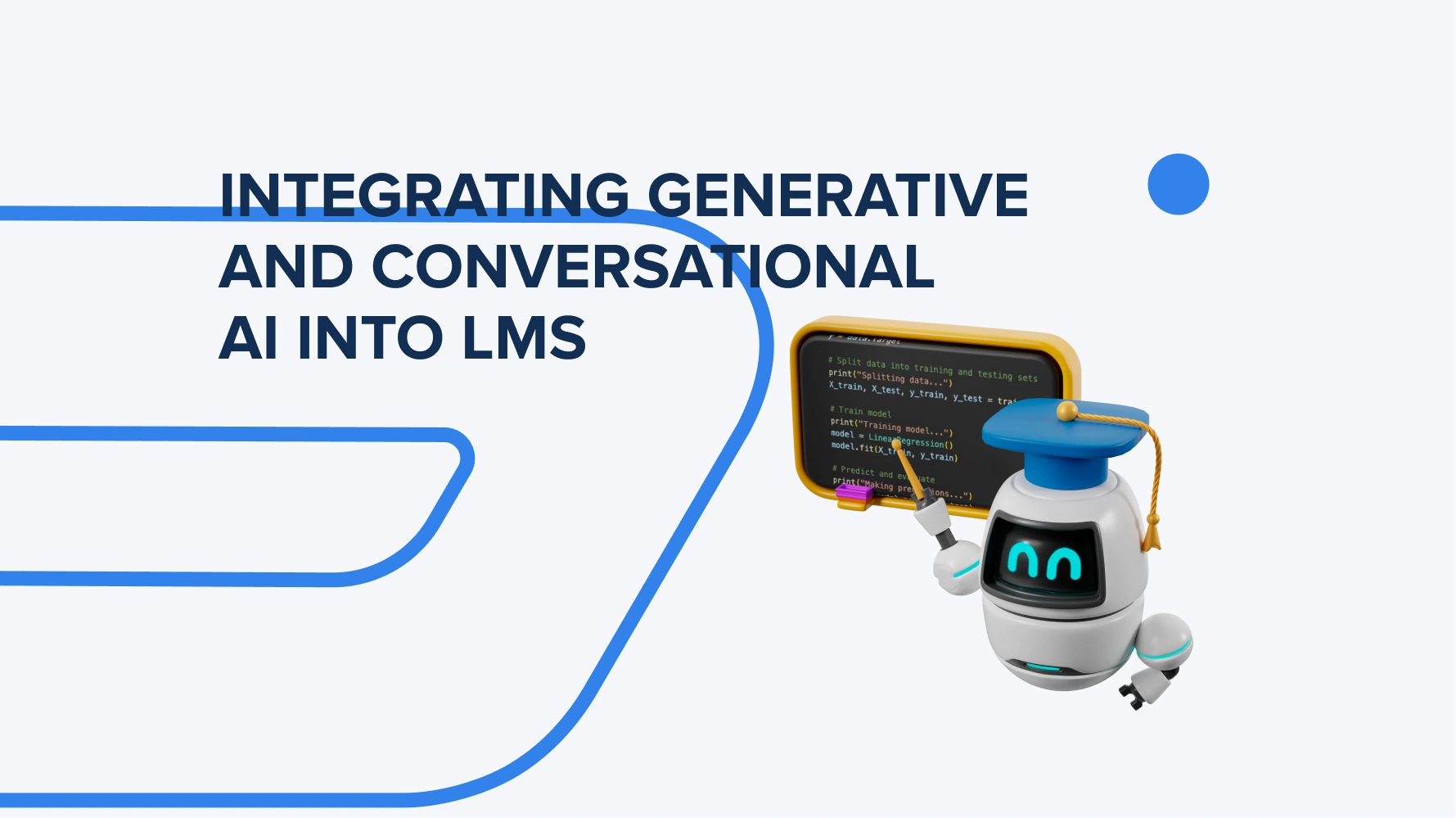
Learn how conversational and generative AI can boost your LMS productivity and help students successfully complete their courses. And what more – how to easily integrate them into your existing LMS platform. Dive in and find more.
AI in Learning Management Systems (LMS)
In the context of the Learning Management System, AI serves as a set of learning models and algorithms that deeply analyze students’ behaviour in the learning platform. Collected data becomes a solid base for further improvements and development – adapt learning courses to students’ needs, give recommendations, and provide support.
Here is what AI does as a smart assistant integrated into an LMS platform:
- Provide adaptive learning. In simple terms, it tracks how much material a student has completed and identifies areas where they are struggling. While deep analyzing, AI creates a list of materials that help students go ahead with the topic.
- Creates and selects appropriate content. The LMS systems have a wide learning & interactive materials library (videos, articles, tests, flashcards, etc.). Whenever a student works on a specific topic, AI suggests additional materials from this library to help strengthen their understanding.
- AI serves as an online assistant via chatbots. If the LMS system consists of a huge learning materials base and courses, it may take some time to find the learning course you need, or an article, for example. How to find it quickly? Ask the AI-bot in online chat. This is just one simple example; there are many other ways it can be applied.
- Predictive analytics for early intervention into students’ progress. Low activity or just several failed tests may be a clear sign for AI to send reminders with advice to meet with the teacher or change the learning path.
- Assessment process automation. Learning models help AI evaluate test answers, short written assignments, and provide instant feedback. For example, students write an essay and download it into the LMS system. AI tools analyze the text, check the structure, identify weaknesses, and provide recommendations. So the teachers have less time for checking the students’ work.
Key steps for integrating AI into an LMS platform
AI integration into the LMS platform requires a pre-analysis stage to identify what exactly tools your institution needs, and of course experienced dev team who will realize this. We’ve covered a step-by-step plan that fully shows what actions to take during AI integration.
- First, outline clear objectives that AI tools will solve as part of the LMS system. It may include increasing course completion rates or reducing administration time. Thus, write down a list of tools that are capable of dealing with them – for personalization, forecasting, chatbot, etc.
- Next, assess the existing infrastructure and its readiness for AI integration. Check if your LMS platform supports API or integrations, and if there is enough data for AI algorithms about users’ behavior.
- After this, choose AI features that can solve the core learning issues and must be integrated first. Build infrastructure around them, using the latest technologies or third-party services. At the same time, think about scalability in the future. When the students’ base becomes bigger – it should withstand the peak loads.
- Then, test integrated solutions on a small group of users. Measure key metrics: engagement, completion rate, average time per course, and user satisfaction. Also, collect feedback from teachers and students to identify what works and what doesn’t, to change your approach.
- After the testing stage, constantly analyze data on how users interact with AI features and whether efficiency has increased. If needed, adjust algorithms, update content, and improve UI/UX based on the data you received.
What are the benefits of integrating AI into an LMS platform?
Integrating AI into an LMS platform brings a bunch of business benefits, oriented also to the learning process. At first, it reduces course administration costs, as many processes (from assessment to reminders) are fully automated. Administrators only checked the data AI provided them.
Learning becomes more effective and fun thanks to personalization features. The system provides users with the right materials at the right time, helping them progress faster and stay engaged throughout the learning journey. Thus, the main aim achieved– students can complete courses faster with positive results.
AI analytics give a deeper understanding of learning outcomes, so you can see the more wider picture of the whole learning system. What does it give you in perspective? A possibility to make smarter choices, spend your budget wisely, and get more value from your corporate training.
Finally, an AI-powered LMS platform improves the user experience. Student and staff members get quick answers via chatbots and have flexible access to content, giving the company a positive image. For this, you don’t need a big team, just an AI algorithm that adapts to the learning needs of every student.

What is the difference between generative and conversational AI in educational applications?
First off, let us bring more clarity to both these approaches.
Generative AI generates (what is obvious) the content for educational apps. For example, it can be new learning materials, tests, short summaries of video lectures, or interactive materials for courses. It works on the basis of large language models (LLMs) capable of generating text, images, or videos that adapt to the course topic and student level. In real life, it looks like this: you upload new course materials on a platform, AI analyzes them, and generates final tests or interactive materials that students can use while learning.
Conversational AI has slightly different tasks. It doesn’t focus on learning materials but more on communication and student support along the learning journey. Typically, it covers voice assistants or chatbots that use NLP models for understanding queries and ensuring interactive, real-time communication. It literally imitates the teacher and gives the answer to all students’ questions regarding the courses or other topics.
Technically, the core difference lies in the AI models and frameworks they use. Generative AI works in context-production mode, while conversational AI is based on dialogue agents integrated via API into LMS. They can also be mixed within a single LMS system.

How can generative AI enhance personalized learning?
The biggest generative AI advantage is that it creates new materials, based on students’ needs and the course’s core points that must be conveyed. AI considers not only what the topic is about, and what to emphasize in interactive materials. It also points out students’ learning tempo and adapts to this and other factors that it collects within the LMS platform.
The vital database for generative AI is the previous students’ results, achievements, and mistakes. Based on this, it generates exercises, tests, or explanations customized to address each learner’s unique knowledge gaps. This is where the real power of personalized learning comes into play.

How can conversational AI improve student engagement?
Conversational AI increases student engagement through ongoing, natural interaction in a chat-like format. It feels like you can talk with AI around the clock, without disturbing the teacher. Thanks to NLP models, it understands the user’s intentions and the context of questions. Thus, it responds in a way that keeps interest and motivation to learn.
Let’s be real, not all students do their tasks on time, so a vast number of questions arise after the sun goes down. From this point, the best assistants for them become online chatbots that know the answers to all questions about the course details. That’s another big reason why student engagement skyrockets when learning involves conversational AI.

What principles should be considered when adding AI features to an LMS?
When integrating AI into an LMS, it’s essential to follow a few core principles. The first thing you need to think about is AI algorithm transparency. Students and teachers need to understand how AI makes decisions or generates recommendations. This will help them get the most from the LMS platform without getting stuck on how to use it. Also, it shortens the training time with LMS and helps adapt faster to the AI working principle.
Technically, the principle of interpretability should also be followed. This means that systems must provide understandable explanations for their actions. Privacy protection is another area to consider. Take it seriously, since an LMS stores sensitive student information.
And last but not least – there has to be a balance between automation and human involvement. AI should work alongside teachers, not take their place, helping them teach with more control and flexibility. Set it up as a digital assistant that is ready to handle time-consuming tasks and improve the learning process and strategies.

How can developers ensure data privacy when using AI in education?
As we said in the previous question, LMS collects sensitive students’ data, so it’s crucial to ensure its safe and protect it from any kind of vulnerabilities. How to do so? Here’s our explanation:
- Limit how much data the LMS collects and select only those that are truly essential for analytics or personalization. That also makes sense to avoid AI algorithms’ overloading with unnecessary data while generating a personalized learning experience.
- To keep users anonymous, data must be anonymized or pseudonymized. So even if there is a case of data loss – LMS users may still remain unidentifiable.
- From a technical standpoint, encrypting data, using secure APIs, and regularly checking for vulnerabilities are a must. This is the core of activities that must be included in the custom LMS development process.
- Only teachers and administrators should be able to see personal information through role-based access control.
- Comply with standards such as GDPR or FERPA, which set the rules for how student data can be stored, used, and shared.
- Users must be clearly informed about how the AI system uses their data in order to obtain permission for its processing. Transparency is just as critical here as security.
What are the most common challenges encountered when implementing AI-based LMS solutions?
AI-based LMS course development and integration is followed by a bunch of challenges. Just like any innovation that needs a careful planned integration. To go through this without losses and stress – choose an experienced tech partner that supports the whole process. Here are the central challenges to keep in mind:
- A lot of LMS platforms are still running on old, outdated architectures. That’s why integration with AI modules requires significant refinement and resources.
- AI models require large amounts of clean, structured data. When using data with poor quality or insufficient representativeness – it may lead to inaccuracies and loss of trust.
- The use of student or employee data and the processing of their behavioral profiles creates risks of privacy violations, non-compliance with standards, and security threats.
- The technology may be brand-new and unfamiliar to the end users – students and teachers. They may not understand how AI works, which slows down implementation and further work.
What successful examples demonstrate the integration of AI into leading LMS platforms?
Here are examples of how companies integrate AI into existing LMS platforms and benefit from this smart decision.
- Georgia State University has introduced an AI-based chatbot called Pounce, which helps students with questions about using the learning system, deadlines, and available resources. The chatbot operates 24/7 and uses an NLP model to recognize student queries. The result is up to a 30% increase in student retention.
- Moodle (version 4.5) with modular AI integration architecture. It has integrated AI plugins that allow customized learning paths, tailored feedback, and detailed analysis of user progress. As an example of successful integration, it has been implemented in several educational institutions.
The University of Economics in Bulgaria has implemented a Moodle program that uses Learning Analytics. It collects analytics on student behavior and helps spot students at risk of dropping out, so timely support can be provided. West University of Timișoara in Romania works with a multifunctional implementation of Moodle with custom plugins and integration of digital learning and assessment processes. Thanks to Moodle log analysis, the university has a better understanding of student behavior (activity time, participation) and adjust course design accordingly.
- Corporate training project with AI-LMS from Aristek Systems. The company created an LMS with a powerful AI component for a large German car manufacturer. Its possibilities cover automatic test generation, content adaptation, and accessibility support for users with dyslexia. Results: +40% employee productivity, −30% time spent on new employee adaptation.
Insights from TRIARE experts on how to successfully integrate AI into an LMS
At TRIARE, we consider AI integration as a strategic institutional tool for learning process improvement and further development. To achieve desired results from AI implementation, we gather all the data that can support the development process. We do this in the discovery phase. There, we deeply study which tasks can be simplified, need quick personalization, or require mentor support.
Our approach is always practical and demonstrates its real-world value. We build AI modules so that they work alongside the client’s team, rather than replacing it. For example, AI can generate personalized learning paths or help teachers quickly assess students’ progress, but the final decision always stays with the human.
Another important area we pay attention to is the database and analytics. We set up the AI in a way that it accurately tracks LMS user behavior, showing clients where students struggle and processes can be improved. This significantly supports course adaptation to real needs with results visible right away.
To see how our approach is already helping clients achieve business goals in education and assess our impact – check our portfolio. Our latest EdTech cases clearly demonstrate how our team tackles modern challenges faced by institutions and helps them overcome these obstacles.
Conclusion
Custom LMS software development is more than building a base for learning materials. It’s about creating an environment where everyone can easily complete tasks and achieve set results. To boost its effectiveness and bring more impact to students’ learning paths, AI tools are widely used today. Generative and conversational AI open this list and demonstrate successfully delivered cases where institutions and businesses implement them and benefit.
If you are on your way to thinking about AI implementation into your LMS platform, check out our insights and approach we use during the same project development. By combining your vision with TRIARE’s deep expertise in AI implementation, we can achieve the impactful results you’re aiming for.