Most Important eCommerce Mobile Apps Features 2025

Approximately 1.65 billion people worldwide shop via mobile phones, representing 30% of the global digital population. Make these stats work for you – add the right features to your e-commerce mobile app and watch your sales go up. In this article, we break down the essentials that help you stay ahead of the competition and win over more customers.
What are e-commerce mobile apps features?
A modern e-commerce mobile app should feel like a cool little store that fits in your pocket. It’s not just about looking good – it has to sell stuff and make people actually want to shop. That means it needs to be fast, friendly, and packed with just the right features. So, here’s what makes it work.
- First things first – signing in. No one wants to waste time here. Let people log in with one tap using social media or email. And if someone just wants to browse? Let them. Guest access is a must as well.
- Then comes the main thing – the catalog. That’s why users opened the app in the first place. Show them clean, scrollable product cards with nice photos and quick info. Tap on one, and boom – detailed descriptions, reviews, maybe even a short video. Make it feel like they’re already shopping.
- To make the experience smoother, give them smart filters – by price, category, brand, whatever helps them find what they’re looking for faster. The easier it is to search, the faster they buy.
- Found the perfect item? Time to hit the cart. It should be easy to tweak the quantity, enter a promo code, or use some bonus points. Everything should feel natural.
- Checkout is where a lot of apps lose people. Don’t be that app. Keep it super clear: choose delivery, pay however’s easiest (card, Apple Pay, Google Pay, even cash), leave a comment if needed, done. But at the same time, keep everything simple and smooth to fill.
- When a user comes back, make sure your e-commerce application remembers them. A personal account where they can check orders, reorder stuff they liked, and collect bonuses goes a long way.
- And don’t forget support and reminders. A friendly chat, a heads-up about an abandoned cart, or a notification for a hot deal – it all helps keep people engaged.
What we wanna say here is that all these little things add up to a big win. A slick, fast, and helpful app means more sales, happier users, and a brand that people remember. Just make sure everything works with one tap.
Why is it important to implement new e-commerce application features?
From a business point of view, having a mobile app for an e-commerce webstore it’s a strategic must-have that directly impacts your success. Why? Two big reasons: staying ahead of the competition and winning over new customers.
Let’s start with the basics. People love convenience. If your competitor already offers photo search, voice commands, or spot-on product suggestions and you don’t – well, guess where users will go? Rolling out new features means you’re keeping up with expectations or even staying one step ahead.
Then there’s the money talk. New features aren’t just shiny buttons, they drive sales. Say you add CRM integration to better understand what your users want, or a “repeat order” button that brings them back without spending on ads. Simple thing that works.
Also, let’s not forget the market. E-commerce is crowded. Like, really crowded. And if your app doesn’t grow, someone else’s will. Features aren’t just functions, they build loyalty, boost repeat purchases, and shape how people see your brand.
Plus, this is mobile we’re talking about. People live on their phones. So if your app doesn’t feel quick, smart, and modern, they’ll swipe it out. Voice search, AR, interactive product pages – users love this. And if they like what they see (and how it works), they’re much more likely to click “buy” and do it again.
What’s the bottom line? New features in an e-commerce app are business tools. They help you sell more, give users a better experience, and keep you competitive. What to add next – it’s up to you.
Who needs e-commerce mobile apps in 2025?
In short, anyone who sells or promotes products or services online. Seriously, in 2025, people are used to shopping from their phones: fast, easy, just a couple of taps to save time. It’s not just about big marketplaces or global brands anymore. Even small and local businesses need to be in their customers’ pockets (like their phones). So if your business lives online, having an app it’s essential.
Here’s who especially needs e-commerce apps right now:
- Retailers and chain stores. They can show off promos, new arrivals, save purchase history, send push reminders, and give out personalized discounts all in one place.
- Local brands. For small and medium businesses, an app is a golden ticket to build a loyal fanbase, skip the extra costs of third-party platforms, and get real insights straight from customer behavior.
- Grocery stores and delivery services. People want quick ordering, saved shopping lists, and accurate delivery time estimates. In 2025, no one wants to call or dig through a browser. They want it fast, easy, and preferably in one tap.
- HoReCa. Restaurants, cafés, and catering businesses use apps for pre-orders, table bookings, and easy payments (bonus points for cashback or bonuses). It’s already a standard part of good service.
- Product manufacturers. Selling directly through an app (no middlemen) is the move. It brings in revenue and helps brands better understand their customers.
Plus, users today expect smooth, fast, and intuitive experiences with a side of AI (like AI search and personalization e-commerce features), recommendation engines, AR fitting rooms, voice search, and lightning-fast payments via Apple Pay or Google Pay. So, when you realize your business needs a shopping mobile app development, the next step is simple – team up with a tech partner who can bring the design wow-factor and build something that really works.

Must-have e-commerce app features 2025
So, now you get why your e-commerce app really needs those must-have features. But what exactly should you pick in 2025, and what does the full feature list look like? Here’s the scoop.
|
Must-have feature |
Why? |
| Fast and easy authorization (social networks, email, guest access) | Nobody wants to waste time signing up or logging in. Quick access means less drop-off and more sales. |
| Convenient product catalog (with high-quality photos, descriptions, videos, and reviews) | People buy with their eyes and trust other users. Good visuals and additional info help them decide faster. |
| Filters and sorting (by category, price, and rating) | It helps users find exactly what they want without endless scrolling. Saves time and boosts chances of purchase. |
| Personalized recommendations | Everyone loves when the app “gets” them and suggests stuff they actually want. It makes shopping easier and drives sales. |
| Intuitive shopping cart (to edit the quantity, enter promotional codes, and use bonuses) | It lets users control their purchases and feel rewarded, keeping them happy. |
| Convenient checkout (with a choice of delivery & payment methods (Apple Pay, Google Pay, cards, etc)) | Because complicated checkouts kill sales. Offering options means fewer abandoned carts and a positive user experience. |
| Personal account (for viewing purchase history, order status, repeat purchases, and accumulation of bonuses) | Users want to track their orders and easily reorder favorites. It builds loyalty. |
| Push notifications (to tell about promotions, order status updates, and reminders about items in the shopping cart) | It keeps users engaged without being annoying, nudging them to complete purchases or check deals. |
| Online support chat (for quick resolution of issues) | Fast help cuts frustration and builds trust, so users stay and buy. |
| Speed of work & adaptive design | Slow apps drive users away. Responsive and mobile-first design ensures the app looks and works perfectly on any device. |
| Voice search to quickly find products | It makes searching faster and hands-free, perfect for busy or multitasking users. |
| AR fitting of goods | It lets users “try before they buy,” reducing returns and boosting confidence in purchases. |
| AI recommendation systems | Because smart tech adapts to users, making the app personal and useful, which helps turn casual browsers into buyers. |
Put these together, and you get an app that’s not only easy and fun to use but also a real powerhouse for your business.

Personalized recommendations & user experience for e-commerce mobile apps
These e-commerce app features work by analyzing what users do, what they like, and what they’ve bought before. The idea is to show them only stuff that fits their taste and interests. Behind the scenes, machine learning and AI pick out the most relevant products for each person.
For businesses, this means more sales, bigger average orders, and happier customers who keep coming back. Users don’t waste time searching — the app suggests products, deals, and bonuses just for them. Plus, it cuts marketing costs since personalized ads hit the right people at the right time.

Secure payment gateway in ecommerce mobile apps
It’s a technology that keeps user data safe during payments, making sure online transactions are secure and recurring payments work without a hitch. From the technical side, it uses encryption, tokenization, and follows global security standards like PCI DSS. Skilled developers set up the payment system testing to protect payments and keep data away from hackers.
For business, this is a must-have. Secure payments build trust, cut down on fraud risks, and prevent financial losses. A solid payment system means more sales, repeat customers, steady income, and a good reputation for your brand.

Robust search and advanced filtering options in e-commerce mobile apps
These tools help users quickly find the right products by filtering through categories, prices, ratings, brands, and more. No more wasting time scrolling or guessing if something fits the budget or preferences. Advanced filters let users narrow down their search with as many details as they want, so the next step is just adding to the cart and checking out.
Tech-wise, this works thanks to smart search algorithms, efficient data indexing, and flexible filtering systems. For businesses, it means the app is easier to use, customers find what they want faster, and the chance of buying goes up. Plus, it makes users happier and encourages them to come back again. Lots of benefits, isn’t it?

Seamless checkout process in ecommerce mobile apps
This is the final step where the user places their order through the app. It’s super important to keep things simple and clear here so users don’t drop off before buying. The form needs to cover key delivery info (address, contact details), offer multiple payment options (cash on delivery, cards, online wallets), and let users apply promo codes or bonuses easily.
Technically, this means smooth data entry, integration with payment systems like Apple Pay and Google Pay, and smart delivery options with address autocomplete or courier services. For business, this cuts down on abandoned carts and speeds up order processing. Plus, a smooth checkout leaves customers happy and coming back for more.
Real-time order tracking in ecommerce mobile apps
This feature lets users track their order status and delivery progress at any time. They can check it in their personal account or get push notifications with real-time updates. It’s convenient to know where the order is and when it will arrive. This transparency builds trust in the brand and gives users confidence that their purchase will be delivered on time and in good condition. Is this the reason for one more order? Of course.
On the technical side, it’s done through integration with logistics services, GPS trackers, and live status updates. For businesses, it means fewer support requests, higher customer trust, and improved user experience, leading to more repeat purchases and a stronger brand reputation.
Multi-language and multi-currency support in e-commerce mobile apps
This feature lets users pick the language and currency they’re most comfortable with. It’s a must if your brand works globally or plans to scale. People should be able to switch to the app version that supports their local language and see prices in their own currency, without using a calculator or Google Translate.
Technically, this aspect is realized through interface localization, integration with currency APIs for current exchange rates, and storing user language settings. For business, this means reaching more markets and a bigger audience, making it easier for people to buy, boosting sales and conversions across countries, and building stronger brand loyalty.
Ratings and reviews system in ecommerce mobile apps
What makes people hit that “buy” button after checking out a product? Reviews. And the rating, based on those reviews. We all check them, whether it’s for a phone case or a coffee machine. That’s why having a rating and review system in your e-commerce mobile app isn’t optional, it’s a must.
Dev teams handle this by integrating a database that collects, stores, shows, and moderates user feedback. For your business, it’s a win: more trust, better reputation, clearer customer insights, and higher sales thanks to that powerful thing called social proof.
Insights from TRIARE experts on features for e-commerce mobile apps
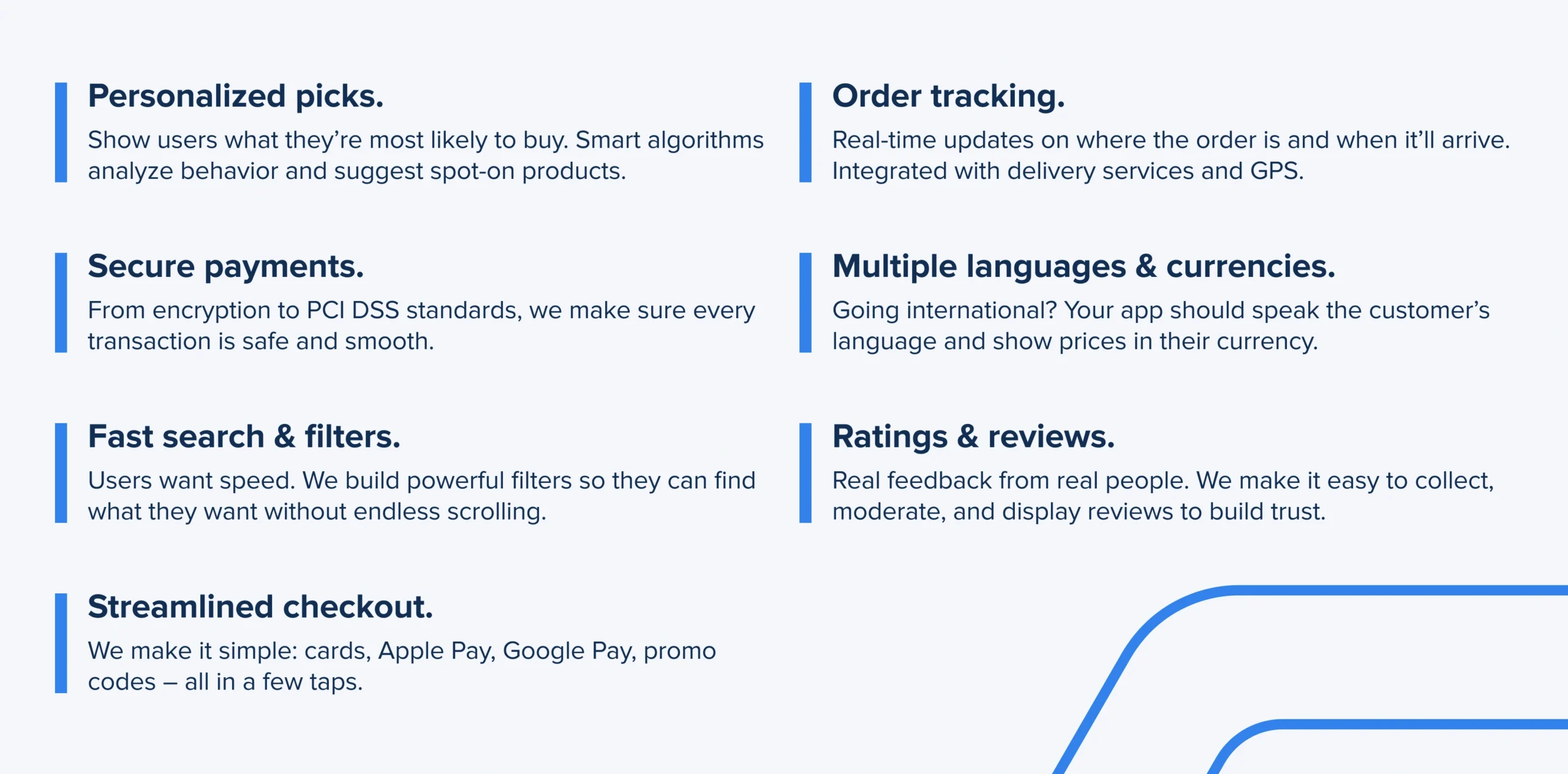
At TRIARE, our experts work on mobile apps for online stores every day. That’s why we know what influences sales and how to create a pleasant user experience. Based on past experience and current e-commerce trends, we recommend the following e-commerce app features:
Conclusions
Online sales are all about staying on trend, constantly updating, and improving for a smoother, more enjoyable customer experience. The more emotions your app sparks, the more likely users are to come back.
Take a look at the features we’ve covered in this article. They’ll help you see what’s working, what’s missing, and where your app can level up. Our team is ready to bring years of experience in e-commerce mobile app development to turn your product into a true growth engine. One that not only looks good but actually sells and keeps customers using your app for online shopping.