Vibe Coding vs AI Software Development Agency: Pros, Cons, and When to Choose Each in 2026
AI offers businesses various ways to develop software – from vibe coding to collaborating with a professional team. The choice depends on the task at hand: validating an idea, streamlining internal processes, or launching a product for customers. Let’s explore where each approach is most appropriate and what to consider when comparing costs, speed, and the quality of the result.
What is vibe coding?
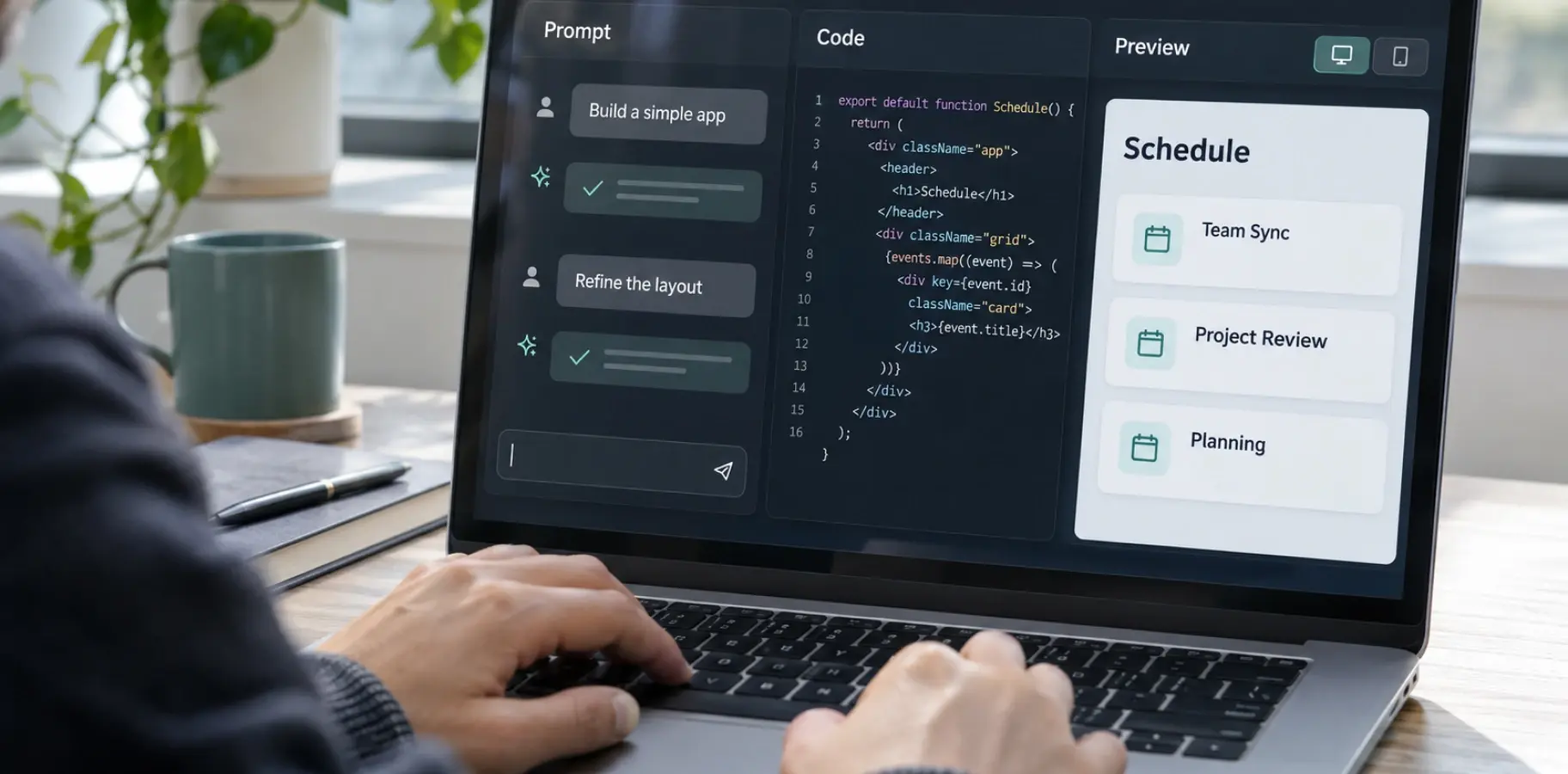
Vibe coding is a way to build software by describing what you want in plain language and letting an AI tool handle much of the coding. You explain how the product should work, its core features, try the result, make changes, and repeat the process.
Andrej Karpathy introduced this term in February 2025. In his 2025 year-end review, he wrote about how natural-language tools are making it easier for people without a programming background to build software. Like, let AI take care of everything while you get the vibe.
But using AI for coding does not automatically make the process vibe coding. A developer may use AI to write a function or suggest a fix and still review the logic, check the code, and stay in control of every change. The difference is how closely the person follows and understands what is being built. In the original sense, vibe coding is more about non-developers fully relying on AI and using it to turn an idea into working software while the AI handles most of the coding.
In the FSE 2026 qualitative study, the authors analyzed 20 video recordings of vibe coding practices and discussions and identified a wide range of behaviors: from almost complete delegation to careful work with the code. This observation helps businesses more accurately define their own approach.
What does the process of vibe coding software look like in 2026?
In 2026, vibe coding follows a simple flow. First, you describe the task, AI generates the app code based on this, then you test it and adjust the instructions. Online, you can find lots of platforms that offer vibe coding development features. Some of them can handle the interface, backend, and deployment, depending on the plan.
Let’s figure out what the vibe coding process looks like. Say you’re building a calculator that gives customers a quick service estimate. The process usually starts with a person describing the app idea and how it should work. They explain what users enter, how each choice affects the result, and what the final output should look like.
Once the first version is ready, they test it in a browser and compare the results with examples they already know are correct. If something is wrong, they change one thing at a time and test again. This makes it easier to see what caused the issue.
When the version works, they save it and note what was tested, what still needs fixing, and any limits they found. The same cycle can be repeated several times until the prototype is ready for the next stage.
In the following paragraph, we disclose the vibe coding pros and cons to give you a wider look at this approach and what to expect from its results.
What are the main advantages of vibe coding for businesses and startups?
The biggest advantage of vibe coding for businesses is the ability to test the product idea viability and its potential through vibe coding development. As a business owner, you can build a basic version and see how people actually use it or whether there’s real demand for it. Based on collected information, you can refine the product concept or rethink the original idea.
To answer the question before it’s asked, vibe coding may seem similar to an MVP, but there’s one important difference. With vibe coding, the company team can build the first product version by themselves, using AI tools. It can be even pre-MVP stage where you can check the product vision without diving into MVP development with the software development teams.
Vibe coding also lowers the organizational barrier to run small-scale experiments. It’s easy to test how an offer is presented, or how an internal sequence of actions is done, without having to set up a separate project for each hypothesis. Value is created even if the application built is not used later on.
For a quick test using demo data, doing vibe coding on your own may be more practical than hiring an agency, especially when the founder has a deep understanding of the subject matter and can personally observe users. The tangible outcome of such an experiment is an informed decision to proceed, modify, or scrap the idea. Deciding against an unnecessary feature is also a valuable outcome of this process.

What are the primary drawbacks of using vibe coding?
The first one is the gap between a convincing demonstration and an understanding of how the program will work under different conditions.
For example, a form may say the data was saved, but everything disappears after the page is refreshed. Asking AI to fix it may accidentally break something else. If you don’t know how those parts are connected, you may end up testing the same things over and over. This is the vibe coding in action – it writes the code but doesn’t consider the use scenarios and dependencies between the features.
And this is what defines AI development as well – it doesn’t get the product logic until you input it into the prompt. With software developers, this process goes faster as they understand these factors and consider them while building a software product. With AI, it may require more conversations and detailed explanations, which it may interpret in its own way. In this case, vibe coding becomes “explain-it-to-AI-a-thousand-times coding.”
Based on this, we have another problem – long prompt histories can get messy. If all the product rules live in one conversation, a new instruction can conflict with something you said before. This is what requires AI, but it becomes a real bottleneck for your team.
AI-generated code can look good but doesn’t work in a real environment. In Stack Overflow’s 2025 survey, 66% of respondents pointed to solutions that were “almost right” but needed more work. The problem is that fixing AI-generated code can sometimes take more time than simply writing it from scratch.
Dependencies can cause trouble too. A 2025 USENIX Security study found examples of models suggesting packages that didn’t exist. So we again go back to the numerous checks and code component reviews.
We hope that looking at vibe coding pros and cons helps you see whether it makes sense to use for your business.
What is an AI software development agency?
An AI software development agency is a software company that uses AI tools and approaches while creating AI-powered products. The experts use AI only where it helps speed up or improve the work, focusing on business needs.
But this doesn’t mean that every product agencies create is packed with AI features. An agency can just use AI tools while building software, and that confirms the AI presence in their work. For example, a customer portal or reporting platform can be a standard software product, but at the development stage, the team uses AI tools.
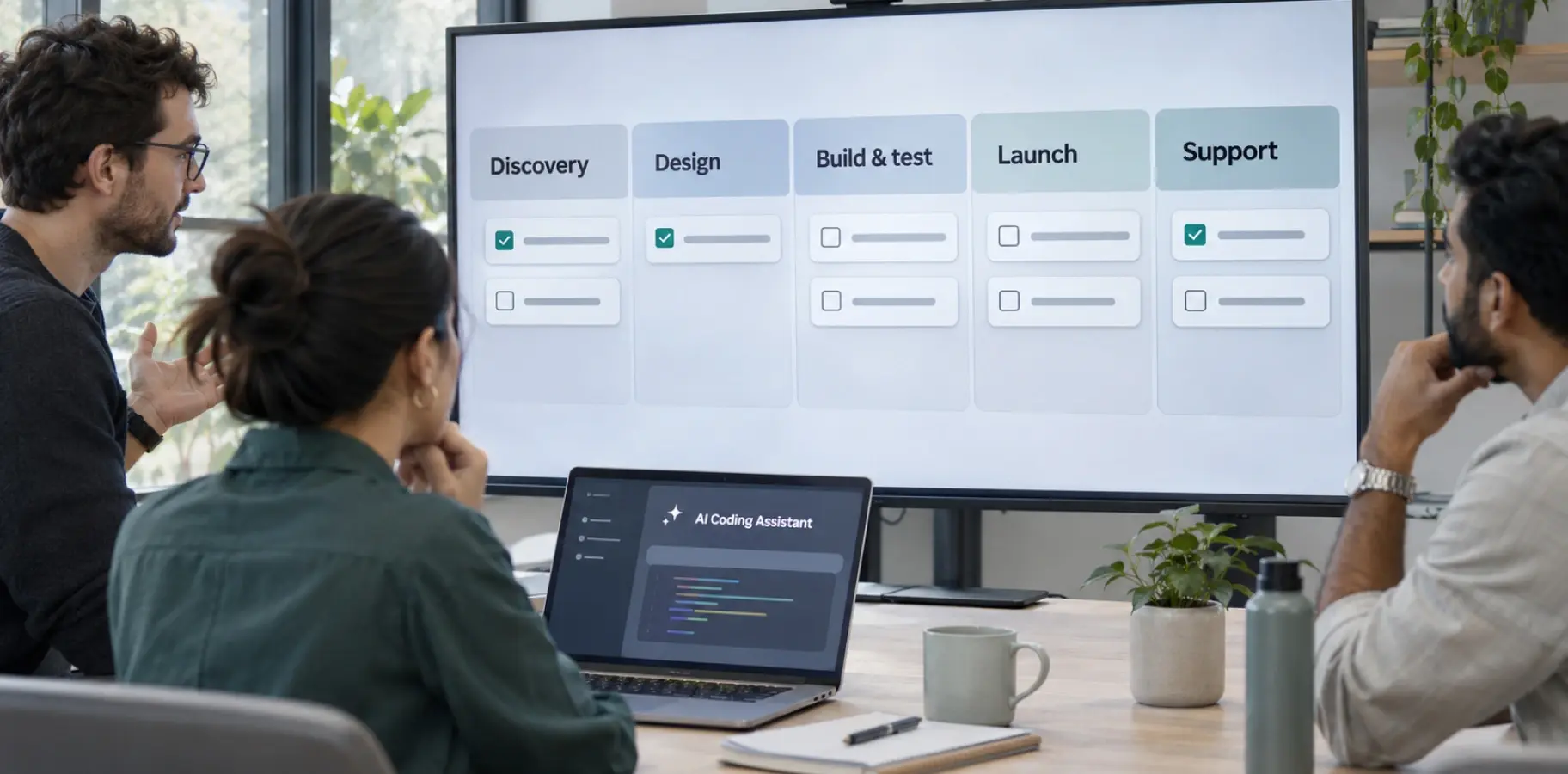
AI can actually touch all the development processes – discovery stage with faster data research, design with AI prototyping and reference creation, development, and testing. No matter how simple or complex the task is, using AI in the development process makes it smarter and faster. The other thing – AI product development and AI integration into the products. These processes require deeper expertise and more technical work from the team, where they use advanced technologies, tools, and go through more development steps to make AI a part of product logic.
How does it create software products?
AI-powered software development goes through the following stages:
Step 1: The team starts with research to understand what kind of product needs to be built and who it’s for. As an outcome, the team gets a list of business requirements, which will be combined with the technical ones.
Step 2: If the product relies on third-party services, the team checks whether the required data and integrations are available. This is an extra research stage that is connected with technical requirements and features that must be implemented through external services.
Step 3: Next, the team defines how data will be stored and how different parts of the system will work together. It’s internal data that helps developers move during development.
Step 4: Here, the development starts. Teams can use AI tools for coding and testing, which then undergo human review. Here, the team realizes all requirements and designs that were approved at the previous stages. In comparison to other processes, this one is the most time-consuming, as the whole product is created here.
Step 5: The team tests the product in different scenarios, finds issues, and fixes anything that doesn’t work as expected. More often, QA specialists use automated testing with AI, as it saves them time.
Step 6: The final development stage. Before launch, the team checks the product from the inside and out. And even here, the team will still be right with you to support your product’s performance and add changes based on users’ feedback.
What are the key benefits of collaborating with an AI software development agency?
The one and main benefit to cooperate with AI software development agency is the possibility to coordinate and be involved into product, design, and technical decisions. Businesses can take advantage of this when changes to functionality affect different departments.
For example, a company wants to add a consultation booking option to its website. The client chooses an available time and gets a confirmation. The manager sees the appointment in their calendar. Once a time is booked, it is no longer available to other clients.
The agency’s team helps figure out how this will work under the software’s hood. They clarify who determines available times and how appointments can be rescheduled. Based on these agreements, the designer creates an intuitive booking form, and the developers configure it to work as intended. As you can see, with an AI software development agency, you get a reliable partner who supports you and guide on every product process and development workflows, translating everything in plain language.
When selecting a contractor, businesses should specifically find out how the team discusses requirements, resolves disputes, and coordinates changes with the client. It’s also important to document these agreements along with explanations. For example, why a client can reschedule a consultation only after the manager’s approval. When a new developer joins the project, they’ll be able to read this explanation and take it into account when making changes. The founder won’t have to reconstruct the entire history of discussions every time.
What are the potential downsides of working with such an agency?
The biggest downsides are connected with development expenses and dependency on the team. Let’s go through all of them.
– Higher development costs. The business pays for the work of specialists, product design, and testing. At the same time, these investments can pay off when the finished product cuts manual work, helps the business serve more customers, or brings in more revenue.
– Longer time to launch. The team refines requirements and tests the product before it goes live. This helps identify issues before customers encounter them. Less rush brings better results.
– Client involvement. A business representative answers questions and approves major changes. At the same time, the team handles technical decisions and implementation testing within the scope of the agreed-upon work.
In what scenarios should a business choose vibe coding?
Vibe coding is a go-to choice for testing the product idea and feature viability, where the team can evaluate everything by themselves, even before MVP development. It is suitable for tasks that don’t require complex integrations with operational systems. Teams often use vibe coding for prototypes, early product experiments, simple web tools, and small internal solutions.
For startups, it can be useful early on when the idea is still changing. Teams can try different concepts, build demo versions, and test features without committing to a fixed development scope too soon. Larger companies can use it for smaller internal needs in marketing, analytics, or operations.
Vibe coding can also be useful during workshops, hackathons, and brainstorming sessions, where the goal is to quickly turn an idea into something people can see and discuss. If that prototype later becomes part of daily operations or reaches customers, it should go through a separate review before being treated as a production product.
When should a business turn to an AI-powered software development agency?
AI-powered software development with a team of experts always makes sense when you’re building a product for real users, improving existing software, or automating processes your business depends on. At that point, you usually need more than a quick prototype. You need people who can handle development, testing, integrations, and support after launch.
For startups, that may mean turning an idea into an MVP that’s ready for real users and a market launch. For established companies, it can mean adding new features, improving older systems, or helping software keep up as the business grows. Bringing in a professional team becomes especially important when the product affects sales, customer service, or commitments to partners.
Agencies also work on internal tools for sales, finance, logistics, and operations. Once a process touches several teams or moves data between different systems, there’s more room for things to go wrong. The setup needs to keep data accurate and make sure the same rules apply across the whole workflow.
The same goes for legacy software. Updating an old system, moving years of data, or connecting new services takes a clear understanding of what already depends on what. The goal is to make improvements without disrupting everyday work.
It also makes sense to bring in an experienced team when the product handles payments, personal data, or user permissions. Adding AI features to a live system comes with extra integration and testing work. In those cases, the right partner is the one that can meet your actual requirements for security, reliability, and ongoing support.
Conclusion
When choosing between vibe coding vs software development agency, always make your decision based on your individual needs rather than the approach’s popularity or what other business choose more often. As we disclosed in this article, both of them have specific use cases, bring benefits for one business type, and don’t support the others.
To get the most from the final product and invest money in the right way – run some research in advance, finding the touchpoints that meet your needs and product technical requirements. We just gave you a wider understanding of vibe coding and cooperation with AI software development companies.
If your choice is definitely cooperation with a development company – contact us, and we’ll help you realize your idea with the help of smart technologies.