How Does the TRIARE Team Automate Pricing on E-commerce Sites
See how the TRIARE team builds e-commerce platforms with pricing automation using modern technologies and proven strategies.
What is pricing automation in e-commerce?
E-commerce pricing automation is a system with specific rules, scenarios, and integrations that automatically calculate and update item prices on e-commerce platforms at every selling step. This means that the team moves away from manually pricing updates and moves toward automated rule-based logic that updates prices, applies discounts, calculates taxes, and manages custom pricing for different customers.
Thus, the system can automatically apply promotional discounts, display customer-specific B2B pricing, calculate shipping costs, account for regional tax rules, and automatically update price lists when procurement costs change.
Before, companies compared automated pricing with dynamic pricing, which is not quite right. Dynamic pricing in e-commerce touches only the pricing creation process, where a list of factors is considered– demand, inventory levels, competitors’ prices, seasonality, and other business rules. Automated pricing in modern e-commerce environments is used as part of the platform’s overall architecture. The system connects to the product catalog, CRM, ERP, checkout, inventory management, and the admin panel, providing a single pricing logic across all sales channels.
This way, companies save on administration time and keep everything under control with the pricing software to respond faster to changes in the product catalog or commercial terms, ensuring customers always see accurate, up-to-date prices, regardless of the sales channel they use.
Why do e-commerce businesses need pricing automation?
When e-commerce businesses grow rapidly, manual price management becomes a tough task for managers and sales teams. This is especially true for large marketplaces with thousands of product listings that need to be updated based on discounts and other pricing factors. In this case, price automation software helps solve a bunch of business tasks at once:
- Large product and SKU (Stock Keeping Unit) management. The system automatically updates prices across thousands of products and variations without manual edits. It’s a huge part of the work that the algorithm does in minutes.
- Multi-market support. The price is formed based on local currencies, tax rules, language versions, and regional price lists across countries.
- Customer-specific pricing. Applies tailored prices, discounts, and terms for B2B, B2C, partners, and loyalty programs. It changes automatically, based on special dates, users’ behaviour, as part of the sales strategy to remind clients about special offers.
- Automated order calculation. Correctly applies promo codes, discounts, taxes, and shipping costs at checkout.
- Fewer pricing errors. Reduces the risk of incorrect prices that can lead to lost revenue, canceled orders, or reduced trust.
- Lower operational workload. Removes the need for manual price updates and speeds up response to product or market changes.
- Consistent pricing across marketing channels. Means the system syncs pricing across web, mobile, marketplaces, and internal systems, ensuring unified rules everywhere. There are fewer misunderstandings and a smoother flow between channels where people buy.

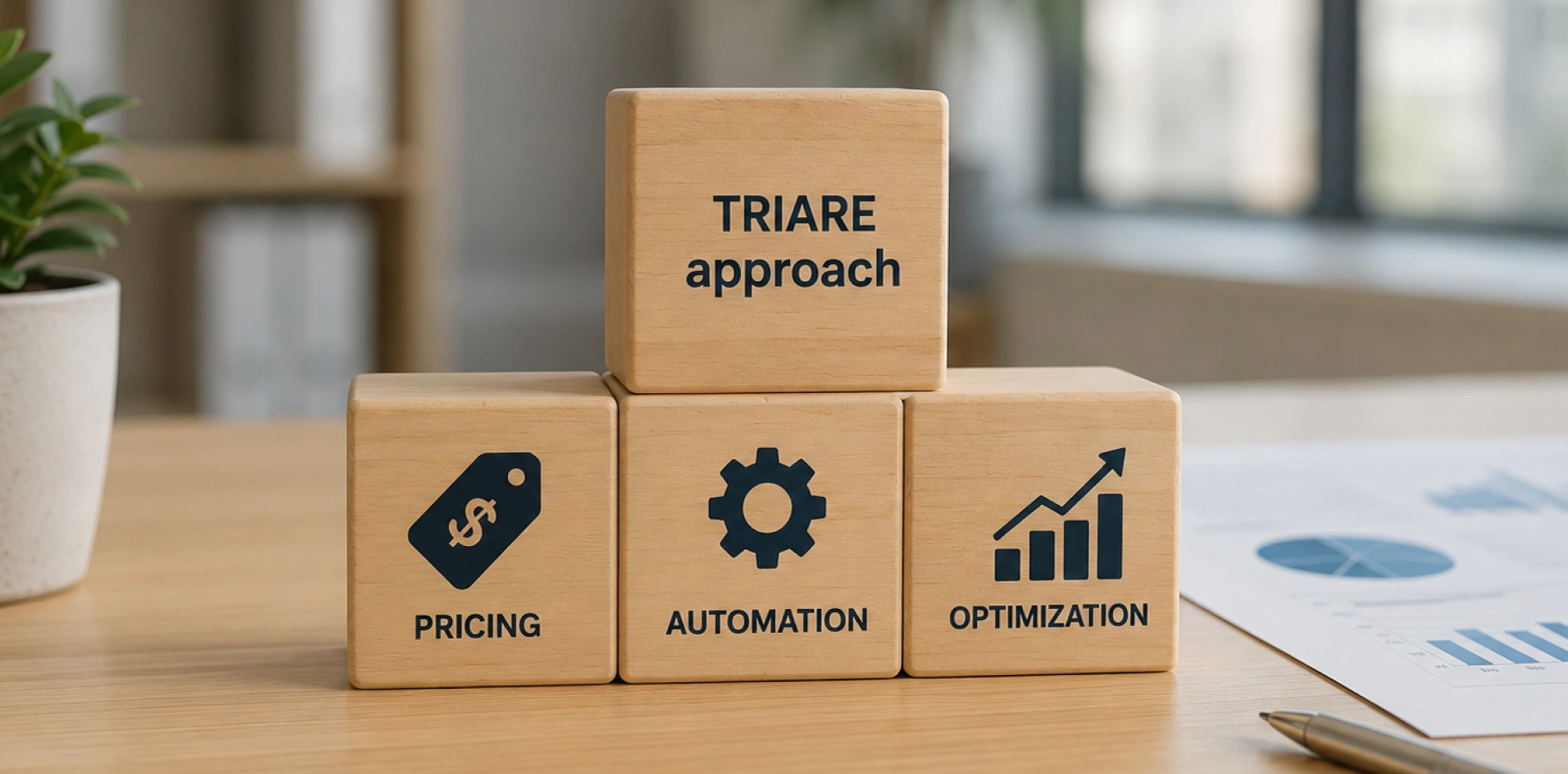
How does TRIARE approach pricing automation projects?
At TRIARE, we worked with lots of e-commerce projects, where the clients’ key requirement was pricing automation, taking additional business factors and their B2C audience localization into account. In every project, we follow a simple core principle that drives business-oriented results – create a custom solution, aligned with company-specific workflows.
The process itself starts from deep research, where our team analyzes current trends on how prices are set, what scenarios exist for different customer types (B2B/B2C), how product catalogs and SKU variations are structured, what tax rules apply across regions, and how discounts, promo codes, and promotions work in different markets. We also pay special attention to user flows and administrative scenarios – how managers control prices and how users interact with them. The final product should meet the existing processes, support, and, in some cases, improve them.
It may seem that every marketplace runs on the same rules and principles, but in reality, companies use absolutely different strategies that touch pricing, listings, inventory management, and other internal workflows. That’s why we dive deeper into this to understand the business logic our client stands for to build the product around it.
Then, we move to the architecture stage, where the development team builds everything so that the pricing logic isn’t hard-coded into the checkout or individual modules, but exists as a centralized, managed system layer. It lets teams add new markets, change tax models, or roll out personalized prices without having to rebuild everything.
All scenarios and architecture vision we translate into easy-to-use and intuitive overall and product page design, to simplify complex processes for the marketplace users. Then we test, improve, launch, and support the final product to make sure it runs smoothly and delivers the results the client expected from the start.
We are completely against the general solutions as they do not work for every business in the same way. Every pricing automation system is tailored to each client’s business model: whether it’s an e-commerce site with thousands of SKUs, a B2B platform with custom price lists, or an international marketplace with multiple currencies and regulations.
This way, we deliver a custom and flexible system that mirrors business logic and scales without compromising pricing control.
How did TRIARE automate region pricing logic for the Team Cuisine project?
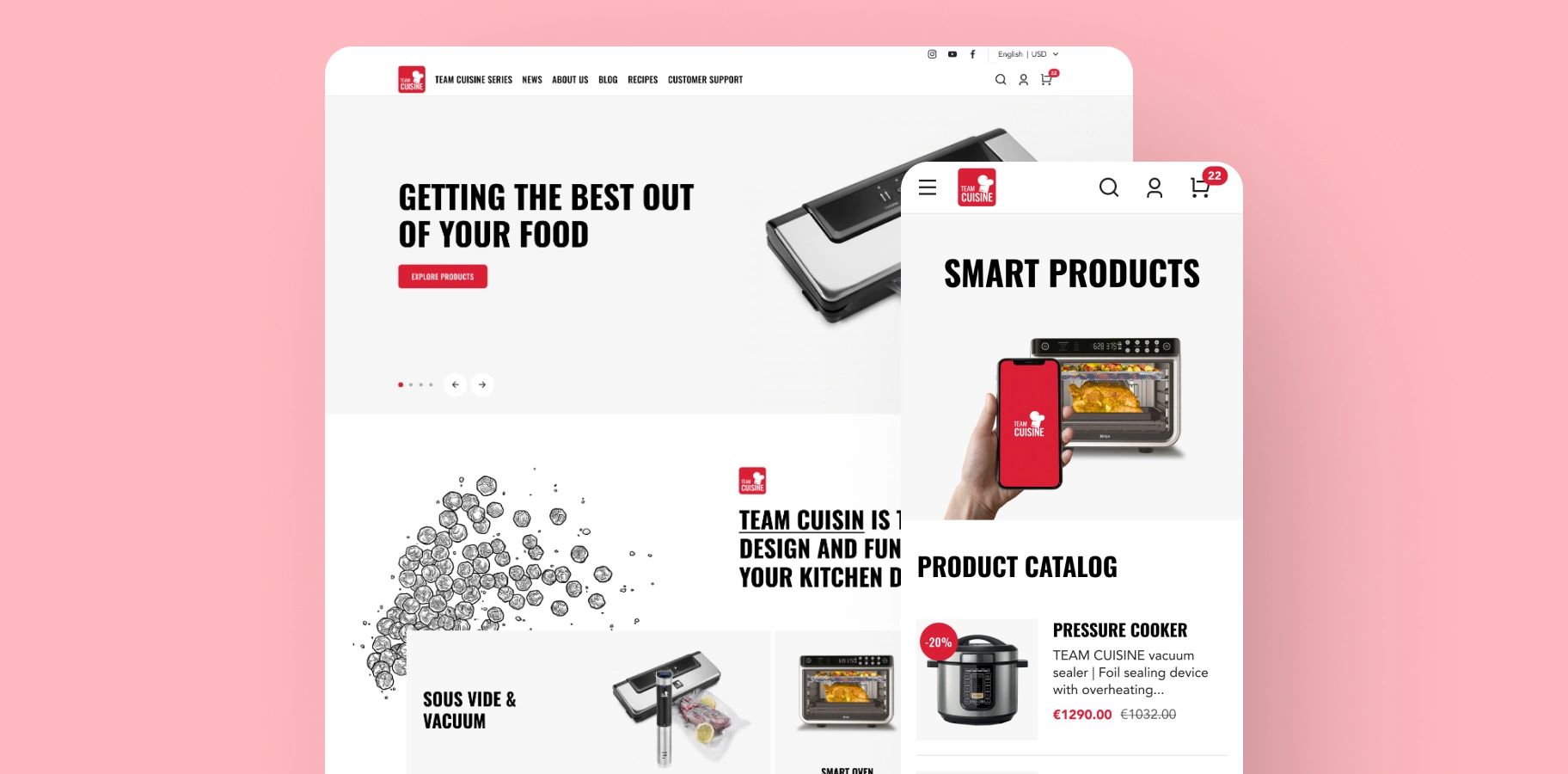
The Team Cuisine is an international e-commerce platform that sells kitchen utilities and operates like a multi-site system for different regions with a centralized hub for managing content, products, and business logic.
Within the project, we were approached to build an e-commerce platform that supports a wide list of items, search features with advanced filters, a coupon system for promotional offers, and a cuisine blog for consumers with no cooking background.
The system consists of three region-specific websites, all managed from a single admin dashboard. Every site can deliver a localized experience without duplicating functionality with centralized catalogs and business logic.
As the core part of the work, the TRIARE team automated regional pricing, so it’s calculated automatically based on the customer’s region and order details. The work principle is based on automatically detecting the region and applying the appropriate tax model: VAT for Europe and sales tax for the U.S., taking into account local tax regulations, which may vary by state. With this, the client’s team doesn’t have to manually adjust prices for every market, which minimizes the risk of errors.
To ensure customers are charged exactly the amount shown at checkout, we realized integration with payment systems – Stripe and PayPal.
The whole pricing logic is now in a separate, manageable layer instead of being hardcoded into the checkout module. As a result, the platform can adapt to new markets, with flexible rule changes, without having to rebuild the whole thing.
In the end, the TRIARE team implemented a system based on WordPress and WooCommerce with integration of the Stripe and PayPal payment systems, ensuring stable online sales operations on a global scale.
How does TRIARE automate discounts, coupons, and promotional pricing?
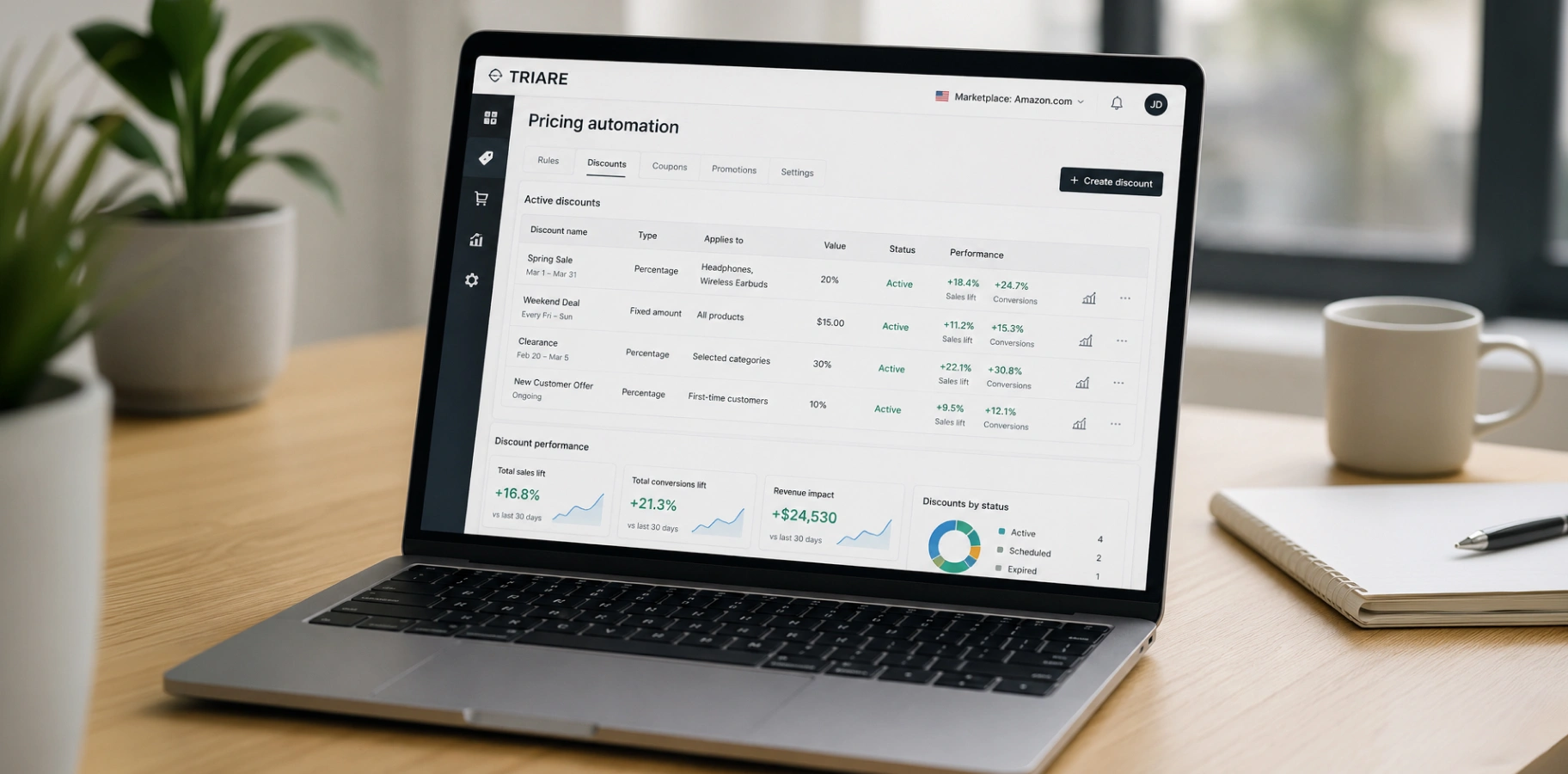
We disclose this question on the Team Cuisine project example. An important part of the work was to implement an automation system for discounts, coupons, and promotional pricing with further integration into the general pricing logic. That makes sense, as promotions and discounts are central to the marketing strategies of most e-commerce businesses. That’s exactly what we realized for the client.
- We analyzed the current promotion and pricing rules. Before development, we mapped out how coupons and discounts should work, which products could be included in promotions, and how promotional offers would interact with the existing pricing logic. We started from this to create a platform with the correct discount offers that align with the product business logic and goals the client sets.
- We integrated coupons into the pricing engine. Instead of treating promo codes as a standalone feature, we made them part of the core pricing logic. When a coupon is applied, the system automatically recalculates the order total based on all relevant factors, including taxes, the customer’s region, and the selected payment method.
- We automated checkout price calculation. As soon as a promo code is applied, the customer sees the updated total. This ensures the amount shown at checkout always matches the amount ultimately charged, eliminating pricing discrepancies during payment. Besides the technical side, this increases customers’ confidence as they see changes immediately and trust the service. This was also what we strive to achieve.
- We made promotions easy to manage. The admin panel allows the e-commerce team to create coupons, update promotion rules, set expiration dates, and manage campaigns without developer involvement or technical skills. All is intuitive and easy to use.
- We built the system for future growth. The centralized pricing architecture enables Team Cuisine staff to launch new promotions, seasonal campaigns, and special offers quickly without changing the system architecture or disrupting the checkout process.
How does pricing automation work with product catalogs and search?
The pricing automation starts at the product catalogue level. That’s the core touchpoint between the customer and the desirable items with the listed prices and available discounts on some of them.
From the system part, the general rules must be clarified – the price customers see, which products are shown in search results, and which conditions apply to each product. If the catalog doesn’t integrate with pricing logic, it’s hard to keep prices up-to-date and scale.
That’s why the TRIARE team designs the product catalog and pricing engine as a single system, where prices are calculated automatically based on product data and predefined rules.
There are multiple factors we take into account during each calculation:
- Product type. Different pricing logic can be applied to simple, configurable, bundled, or digital products.
- Product variations. Attributes such as size, color, material, or other options can affect the final price of each SKU.
- Inventory status. The system can hide out-of-stock products, adjust pricing, or trigger specific pricing rules based on inventory levels.
- Product category. Category-specific discounts, markups, or promotions can be applied automatically to all products within that category.
- Customer location. Prices are adjusted automatically based on local taxes, currency, and regional pricing rules.
- Customer type. B2B and B2C customers, partners, and VIP users can each receive different pricing based on predefined conditions.
- Related products. Bundle discounts, cross-sells, and special offers are applied automatically when eligible products are combined.
What is in the outcome? Customers see only region-available products with correct prices and relevant promotions, while businesses get a unified, scalable system for catalog and pricing management.

How can pricing automation improve checkout and tax accuracy?
The price optimization approach ensures that the final order total is accurate, transparent, and compliant with local tax and financial regulations.
As part of pricing automation, the system automatically considers the user’s region, applicable tax type, and local tax rules, which vary by country or state. For example, VAT is applied in Europe, while the U.S. uses sales tax that can differ by jurisdiction. It also takes into account currency, payment method, and specific payment provider requirements (such as Stripe or PayPal) to ensure consistency between the calculated and final charged amount.
This approach eliminates the need to apply taxes manually or calculate them separately at checkout – something that often leads to errors. Instead, all logic is centralized within a single pricing system.
This is how it works in practice.
| Step | What happens | Result |
| Region detection | System identifies the user’s location (country/state). | The correct tax model is selected (VAT, sales tax, etc.). |
| Tax rules application | Local tax regulations are applied automatically. | Accurate tax calculation based on jurisdiction. |
| Price calculation | Base price + discounts + taxes + currency adjustments are combined. | The final payable amount is generated in real time. |
| Checkout processing | Pricing data is passed to checkout and payment gateway (Stripe, PayPal, etc.). | Consistent price across UI and payment system. |
| Payment execution | The payment provider charges the exact calculated amount. | No discrepancies, full compliance with payment rules. |
What technology stack does TRIARE use for e-commerce pricing automation?
At TRIARE, we use only the latest tools and technologies that already prove their effectiveness and can really improve the product quality and productivity. We also don’t use the same tech stack for different projects and feature development; our team carefully selects the right tools and technologies for each web and mobile product, focusing on the features that matter most.
From this point, for e-commerce platforms, we pick a tech stack depending on the complexity of the business logic, the scale of the system, and the level of customization required by the client. A key principle of pricing automation is that it shouldn’t be complicated. It should be manageable, transparent, and scalable.
In standard e-commerce scenarios, such as the Team Cuisine project, TRIARE developers built solutions based on PHP, WordPress, and WooCommerce, with integration of the Stripe and PayPal payment systems. WooCommerce serves as the foundation for checkout and basic pricing rules, while custom logic is added via the PHP layer and integrations with payment providers. This stack creates a single management environment, allowing the team to control products, promotions, coupons, and checkout logic through one centralized admin dashboard.
In more complex projects where WooCommerce’s standard capabilities are insufficient, the TRIARE team used an extended stack: WordPress, PHP, Ruby on Rails, React, JavaScript, Node.js, as well as the iOS and Android mobile platforms. Such systems go beyond traditional e-commerce and include CRM functionality, custom APIs, multilevel user roles, and complex workflows for managing the product catalog and leads.
When should an ecommerce business build custom pricing automation?
For small and mid-sized marketplaces, WooCommerce, Shopify, and ready-made plugins are enough to create simple pricing logic. But over time, the business will grow, and there must be a reliable system that supports a growing user base and business processes within the e-commerce platform. In this case, only custom development can help keep up with growth.
Custom pricing automation makes sense if your business has:
- Selling across multiple countries. Support for different currencies, tax regulations, and regional price lists.
- Advanced pricing logic. Pricing goes beyond basic discounts and promo codes, incorporating custom business rules.
- Customer-specific pricing. Different prices and terms for B2B and B2C customers, partners, dealers, and corporate clients.
- Large product catalogs. Automatically manage pricing for thousands of SKUs and product variations without manual updates.
- Business system integrations. Sync prices, inventory, and commercial data with ERP, CRM, PIM, and other internal systems.
- Custom checkout logic. Calculate prices based on order contents, shipping method, customer location, and other business-specific factors.
- Personalized price lists. Deliver tailored pricing for individual customers or customer groups.
- Workflow automation. Reduce manual work, speed up order processing, and minimize pricing errors.
Conclusion
Effective pricing doesn’t only cover setting the right prices but also ensures your entire e-commerce ecosystem works together seamlessly. As for pricing automation, it reduces errors, simplifies catalog management, speeds up order processing, and creates room for future growth.
At TRIARE, we build custom e-commerce solutions designed specifically around your business. Whether you need advanced pricing logic, an automated checkout process, integrations with your CRM, ERP, product catalog, or a scalable platform that grows with your business, we can help you realize this.