Biometric Identification Services and ID Verification for Mobile Apps
Mobile biometric verification is an integral part of most applications. Learn how Individuals can be confident in their personal information when using software products from their favorite brands.
Intro. What is Mobile Biometrics authentication and identification?
Biometrics is a field of science that studies methods for measuring a person’s physical characteristics and behavioral traits for subsequent identification and authentication of the individual. The biometric characteristics of people represent their measured physical features or personal behavioral traits. An identification procedure is implemented to compare them with a similar previously registered biometric characteristic of a person. The main sources of a person’s biometric characteristics involve fingerprints, iris, and retina, voice, face, manner of working on a computer keyboard, signature, gait, etc.
Mobile biometrics authentication implies an authentication procedure, such as verifying the user’s authenticity by comparing the entered password with a password stored in a database.
Mobile biometrics identification represents a procedure for recognizing a user by personal identifier. This function is executed when a user tries to log on to the application.
Government and border management agencies were the most valuable clients in the global biometric identification services market in 2020, with a valuation of over 3.5 billion US dollars. With end users in banking and financial institutions exceeding two billion dollars, the global market for authentication and identification is expected to reach almost 8.8 billion dollars by 2026.
What are the different types of biometrics?
According to Spiceworks research, more than 60% of companies in Europe and North America use biometrics to protect data and believe this method is more secure than a PIN code or a combination of login and password. More than 10% of respondents are confident that only biometrics are sufficient for identification, while other companies insist on using additional methods.
The most popular types of biometrics used for identification services imply the following methods:
Fingerprint. Each mobile device manufacturer offers specific capabilities to identify a user by fingerprint and securely store his data. For example, a fingerprint sample is run through a hash function on Apple devices before being stored in a secure computing module. All Touch ID-related processes occur in this module. The level of security on Android devices is associated with the approaches and solutions used by the manufacturers. Leading smartphone manufacturers, such as Samsung, use fairly reliable and accurate capacitive sensors to ensure high data security.
Face ID. Scanning is carried out using a capacitive camera if the application identifies the user by face. Compared to the previous method, this one needs an even more complex algorithm, requiring high-precision image capture and distribution of more than 30 thousand control points over the user face image. This approach sets higher demands on the smartphone camera. The capacitive scanner studies the user’s face, building a geometric model and converting it into calculation results that can be stored. During authorization, the calculation result for a specific user is compared with the result stored in memory.
Speaker recognition. Voice identification analyzes unique speech characteristics determined by anatomical features and acquired habits. There are two types of speech recognition systems, including hybrid and end2end. End2end translates a sequence of sounds into a string of letters. Hybrid systems contain an acoustic and language model that operates independently.
Iris and hand geometry scanners. This technology scans the iris, which surrounds the pupil. The scanner determines certain features of the user’s appearance and the geometric shape of the iris using capacitive cameras. The same process occurs during scanning hand geometry.
The most developed technologies currently include fingerprint recognition, iris recognition, and two-dimensional facial image scanning. Moreover, fingerprint identification is currently several times superior to all other technologies in terms of applicability and accessibility from a financial point of view.

Why is ID verification through biometrics relevant now?
Biometric identity verification is becoming more popular every year. Such technologies are integrated into various areas worldwide by becoming firmly established in almost every person’s life. Biometrics are used in most modern mobile devices.
ID verification through biometrics is extremely relevant now due to the following advantages:
Safety. Biometrics are extremely difficult to fake. Each biometric feature is unique by definition for each person. It is almost impossible to deceive the system.
Accountability. Biometrics provide strong authentication and accountability, allowing the users to know exactly who acted. In the case of biometric authentication, direct interaction is required to log in, which ensures 100% control over all users’ actions.
Stability. Biometric data is stable and resilient. It changes very little over a lifetime, allowing a person to be identified despite small changes.
Convenience. Following best practices, passwords are kept complex. Frequent changes for security purposes each time cause inconvenience because a new complex password is needed. A person’s biometric data is always ready for scanning.
Biometric authentication can offer various benefits to businesses and organizations. It provides secure and convenient user authentication by delivering cost savings and increased user satisfaction. For these reasons, biometric authentication quickly becomes the preferred choice for businesses and organizations.
Before using ID verification and biometrics on mobile apps, what should a business know?
Biometric identification services have turned into an integral part of the control systems. Companies using biometric security systems can benefit from superior accuracy and unparalleled protection of sensitive information. Correctly captured fingerprint, retinal, and iris scans produce unique data sets. Once an employee or user is enrolled in a biometric security system, automatic identification can be performed consistently, quickly, and with minimal training.
Business owners should know the following shortcomings of the systems before using ID verification and biometrics on mobile apps:
- Availability of biometric identifiers for copying and attack in most biometric identification systems.
- The need for certain environmental conditions to carry out biometric identification.
- The emergence of situations when biometric identifiers are damaged or unreadable.
- The presence of errors in the first and second types.
- The necessity to ensure the requirements of regulators for the protection of biometric personal data.
A mobile phone is the most universal device for reading biometric data. New biometric identification technologies will likely be implemented in these devices. Mobile phones will become multi-factor biometric scanners.

What benefits can ID verification and biometrics for a mobile app provide for business?
User authentication through passwords to gain access to information systems has many disadvantages. According to statistics, passwords do not change for a long time. They are often duplicated in different applications, written down on handy notes, and transferred “temporarily” to other users.
ID verification solutions have the following benefits for business mobile apps:
Increased security. Biometric authentication is one of the most secure forms of authentication. Traditional authentication methods, such as passwords and PINs, can be easily guessed or hacked. However, biometric authentication relies on physical characteristics such as fingerprints or retinal scans that are unique to each individual.
Improved convenience. Biometric authentication eliminates the need for users to remember passwords or PINs. This nuance can benefit businesses and organizations with large numbers of users, as it eliminates the need to manage and reset passwords. Biometric authentication also allows users to quickly and easily access data and resources since they no longer have to enter a password or PIN each time they access the system.
Financial savings. Biometric authentication can be a cost-effective solution for businesses and organizations. This approach eliminates the need for expensive passwords and PINs and reduces the need for IT support staff to manage and reset passwords. Additionally, biometric authentication can reduce the risk of fraud and identity theft, saving businesses and organizations time and money.
Improved user interface. Biometric authentication provides more secure and convenient authentication for users. This fact can benefit businesses and organizations as it can help improve user satisfaction and loyalty. It can also help reduce user frustration as they no longer have to remember and enter complex passwords or PINs.
Constantly improving modern technologies make it possible to introduce any biometric authentication technology, the most promising seems to be the use of several biometric authentications simultaneously. Multifactor authentication systems are one of the most effective methods of biometrics.
How does biometric verification work in mobile apps?
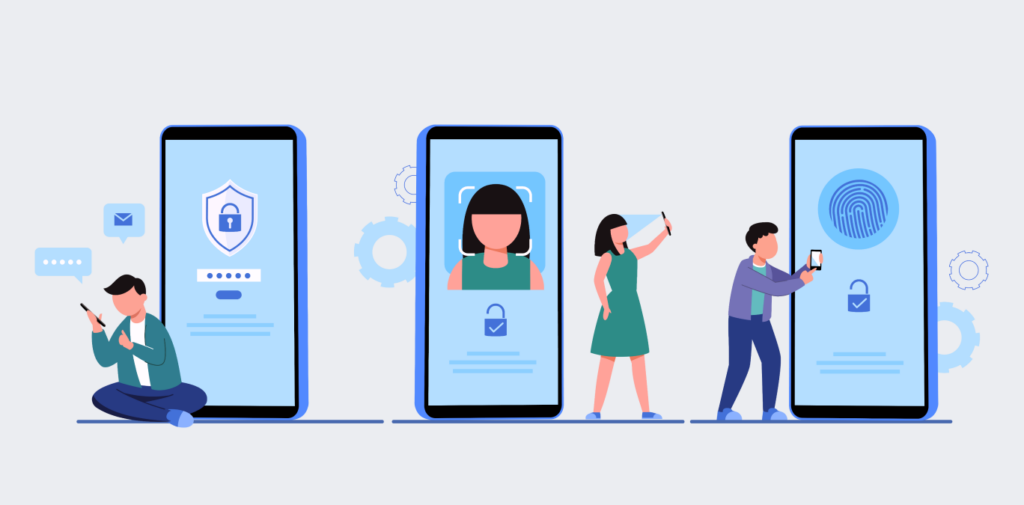
When using any of the biometric scanners, absolute accuracy is unattainable. When a user scans a fingerprint, the resulting pattern depends on the force of pressure, a displacement of a fraction of a millimeter to the right or left, and the presence of minor injuries to the skin. The results of several scans of the face or fingerprints of the same user always contain differences. In this case, the fuzzy search method is used for authorization by face or fingerprint.
The process of biometric identity verification involves the following steps:
- A biometric scan captures an image.
- The algorithm extracts the same stable features as during registration.
- Public code tells the system “where the functions are” to find private code.
- The same private code is generated.
- Cryptographic keys and hash are issued for authentication.
In this case, the application does not look for completely matching elements, as in password hashing, but rather for entities most similar. The data has to be stored entirely because a hash function that produces close values for similar symbol combinations is not secure enough.
Successful cases of ID verification and biometrics for mobile applications
Biometrics have become an integral part of the modern world, providing new opportunities and increasing convenience in digital progress. Their use is becoming increasingly widespread. However, with the growing popularity of biometrics, issues related to privacy arise. It is necessary to strictly monitor how they are collected, stored, and used to prevent possible misuse and information leaks.
The successful ID verification solutions for mobile apps include the following cases:
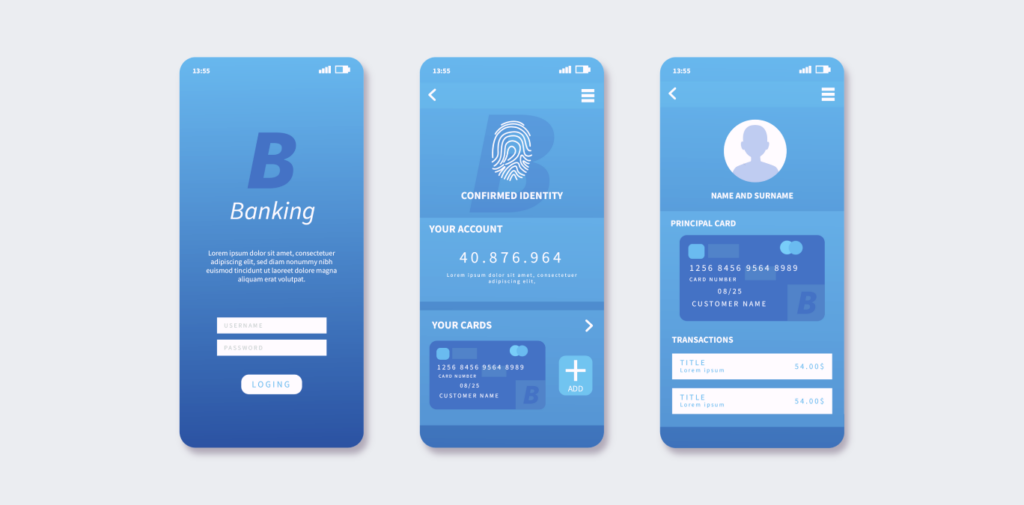
- A biometric payment system point-of-sale (POS) uses distinctive physical traits to confirm a user’s identity and authorize the withdrawal of money from their bank account. Apple Pay and Google Pay are two well-known examples of biometric payment systems. With their help, customers can make purchases using Touch ID or Face ID.
- Identity verification fintech company authID has acquired a new client. The biometric authentication platform from authID will be used by payments-focused startup Bieases for its new digital wallet. Based in California, the company provides cross-border payments, P2P, and P2B digital banking services in the US, UK, and EU.
Biometric recognition systems show growing demand among modern individuals, greatly facilitating and simplifying the processes of gaining access. They also help large businesses automate behavioral analysis processes and detect potential attackers, proving to be indispensable assistants in addition to traditional security methods.
What does TRIARE know about successfully implementing ID verification and biometrics?
Biometric identification services’ continued integration into people’s daily lives is moving the industry toward its long-standing ally of eliminating the hassle and risk associated with entering PINs and passwords. Biometrics provides more convenient access control options. With the latest biometric solutions, users will have more and more options to combine convenience with security. With the growing popularity of biometric verification models, integrators are faced with new security requirements.
TRIARE offers its clients a wide range of the following services:
- Development of an application with an advanced biometric verification system.
- Modernization of an existing digital product to introduce biometric verification options.
- Creation of a software package for implementing complex privacy policies using biometric scanners.
- Support for software products with complex biometric user authentication systems.
TRIARE pays special attention to the ways of application improvement. This approach represents a basis for increasing a company’s profit and level of competitiveness. The developers provide their clients with adaptive and effective application modernization strategies.
Conclusion
The development of the mobile biometrics market segment is associated with the active use of smartphones with pre-installed sensors. At the same time, biometric identification services for authentication will be used not only for unlocking mobile devices but also for organizing multi-factor authentication and instant confirmation of electronic payments. TRIARE provides its clients with high-quality digital products as a basis for safe interaction with clients through mobile applications. The business owners will get an opportunity to take their companies to the next level of development.