Top 5 Web Companies Developing Real Estate Asset Management Solutions
Real estate asset management software can take very different forms – from ready-made SaaS platforms to fully custom systems and specialized data APIs. In this article, we compare five providers across these categories, looking at their capabilities, integrations, best-fit use cases, and key considerations to help businesses choose the right approach.
What are real estate asset management solutions?
Real estate asset management solutions are digital systems that help owners, investors, and asset managers bring real estate data into one place, track asset performance, and make portfolio-level decisions.
It’s important to understand that asset management and property management areas are related, but they’re not the same. Let’s make it clearer.
Property management primarily covers day-to-day real estate operations. It includes leasing, payments, communication with tenants, maintenance, and individual property management.
Asset management, instead, focuses on the performance of real estate as an investment. It typically covers financial results, risks, asset value, and overall portfolio performance.
Therefore, real estate asset management solutions may include specific features to help investors manage their investments wisely. Like, portfolio dashboards, budgeting and forecasting, investment accounting, investor reporting, KPI analysis, document management, and integrations with other corporate systems. In other words, it covers all the financial side of asset management and features that support it.
However, a real estate asset management solution doesn’t always mean a ready-made SaaS product. In practice, there are three models that businesses can choose from:
– a ready-made software platform that the company integrates into internal processes;
– custom development, where the system or individual modules are built from scratch, according to specific business logic and integration requirements.
– a data infrastructure.
Therefore, choosing the right solution should start by defining what your business actually needs: a ready-made product, a custom system, or an external data layer.
What are the requirements for real estate asset management software in 2026?
By 2026, real estate asset management software should offer options beyond simply storing information about properties. Its real value comes from integrating data from various systems, ensuring secure access, and providing asset managers with an up-to-date picture of portfolio performance.
To answer “What is real estate asset management software?”, think of it as the technology layer between real estate data and portfolio decisions. The system collects information from various sources and then transforms it into dashboards, calculations, reports, and workflows that the team uses to manage assets. The modern real estate market creates a clear set of requirements for how digital products should support business operations. Let’s dive into each of them.
Data integration
Real estate businesses rarely operate within a single system. Different data types are stored and processed on various system levels. For example, property data may be stored in a PMS or sourced from an MLS, financial information from accounting or ERP software, and investor data from a CRM or a separate investment management platform.
Therefore, integrations must be part of the architecture. It is necessary to determine which system serves as the source of truth, how records are synchronized, how duplicates and errors are handled, and who has access to specific categories of data.
Dashboards and analytics
Asset managers need more than just access to large amounts of information; they need the ability to quickly see the status of their portfolio. That is why dashboards, financial modeling, reporting, budgeting, and forecasting remain key components of such systems. It gives a wider picture of what’s going on with assets and what forecasts to rely on.
Security and access control
Asset management systems may contain financial metrics, investment data, ownership information, and other sensitive business data. Therefore, when choosing software, evaluate features like authentication, role-based permissions, encryption, audit logging, backups, infrastructure security, and recovery procedures. For enterprise clients, independent security standards and certifications may be of particular importance.
Custom vs off-the-shelf real estate software
Off-the-shelf SaaS makes sense when its standard workflows closely match a company’s daily workflows and main processes. In this case, the business gains access to pre-built functionality and avoids the cost of developing it from scratch.
A custom solution becomes more relevant when a company has proprietary workflows, its own calculation rules, non-standard dashboards, legacy software, or a complex combination of PMS, ERP, CRM, and external data sources. These factors require custom software development, integrating only the necessary features for the company that support effective asset management for all participants.
So, when comparing custom versus off-the-shelf real estate software, consider the total cost of ownership. The initial cost is just one factor. You also need to account for implementation, subscriptions, integrations, data migration, infrastructure, maintenance, and future changes.
For custom development, code and IP ownership must be defined separately. This is especially important for companies that view software not merely as an internal tool, but as a long-term technological asset.
How do you select a provider for real estate asset management software development?
To choose a real estate software development company, at the very beginning determine which model you need – off-the-shelf SaaS, custom development, or a data/API provider. Then compare features, integrations, security, costs, and support they offer to match their approaches with your individual business needs.
This is a key point. For instance, the companies we’ve highlighted in this article offer various types of services and work with different project types. RealPage and Juniper Square provide off-the-shelf technology platforms. TRIARE and Inoxoft develop software tailored to the specific business needs. Constellation Data Labs provides real estate data that these products can utilize.
If a custom solution is what you need, start the assessment with the discovery phase and architecture. The team must deeply understand the business processes, users, data sources, integrations, technical constraints, and MVP priorities. Without this, an early estimate of the budget and timeline will be too approximate.
The second criterion is relevant domain experience. For asset management, it’s important to have experience not just with real estate websites, but with portfolio management, financial calculations, dashboards, data-heavy systems, and third-party integrations. As these require specific technical skills and awareness of how asset management processes work, the team must be familiar with all these things as well.
The next criterion is integration capabilities. Even before the project begins, you need to identify the PMS, ERP integration, accounting, CRM, MLS, and other systems that must exchange data. The mere presence of an API is not enough: it’s important to understand the synchronization logic, data mapping, error handling, and the responsibilities of each system. If integrations are considered too late, after the scope and architecture are already set, they can disrupt the development plan and increase costs. That’s why they should be discussed early, while the team is defining priorities and technical dependencies.
Assess security requirements separately. For SaaS, verify the declared controls and certifications. For custom software, security requirements must be built directly into the architecture and development scope.
Another criterion is the solution’s cost-effectiveness. For SaaS, you need to account for implementation and recurring subscription costs. Custom development requires considering discovery, design, engineering, QA, infrastructure, and maintenance.
Finally, even before signing a contract with a custom development partner for real estate asset management software development, agree on extra crucial factors:
– code and IP ownership,
– documentation, infrastructure access,
– post-launch support,
– the process for the product’s future development.
Who are the top 5 real estate asset management solution development companies?
TRIARE, RealPage, Juniper Square, Inoxoft, and Constellation Data Labs are five relevant providers for real estate asset management. Nevertheless, they cover different parts of the technology stack, follow different approaches, work with different project types, and are not direct competitors.
TRIARE and Inoxoft are custom software development companies. RealPage and Juniper Square are vendors of off-the-shelf software platforms. Constellation Data Labs is a data and API provider.
That’s why we compare not only the companies’ capabilities, but also the business model behind each one.
1. TRIARE
Provider type: custom software development company.
TRIARE is ideal for companies that need their own real estate platform, custom modules, or an upgrade to their existing system instead of switching to a standard SaaS solution.
In the real estate sector, TRIARE works with property listing platforms, custom CRMs, property management systems, analytics dashboards, and integrations with MLS and third-party services. For real estate investment firms, the company also develops dashboards to monitor portfolio performance, return forecasts, and investment opportunities.
The most relevant example in asset management is the Arctic Real Estate Management System. This is a platform for managing real estate investment projects, which TRIARE modernized based on the actual workflows of business managers.
The team optimized the creation and configuration of real estate projects, improved property calculation formulas, and integrated third-party services. Alongside this, the dashboard was also redesigned to provide users with a centralized overview of portfolio information.
Integrations: The custom architecture development the company offers includes designing APIs and data integrations around a specific set of ERP, PMS, CRM, or external data systems.
Best fit: Investment firms, real estate businesses, and PropTech companies. Those with proprietary workflows, non-standard business logic, legacy systems, or a need for custom modules and dashboards.
Considerations: Custom development involves discovery, architecture, development, and QA, so building an MVP usually requires more upfront time and resources than launching a ready-made SaaS product. Before development, define the project scope, clarify ownership, plan the infrastructure, and agree on how the product will be supported after launch.

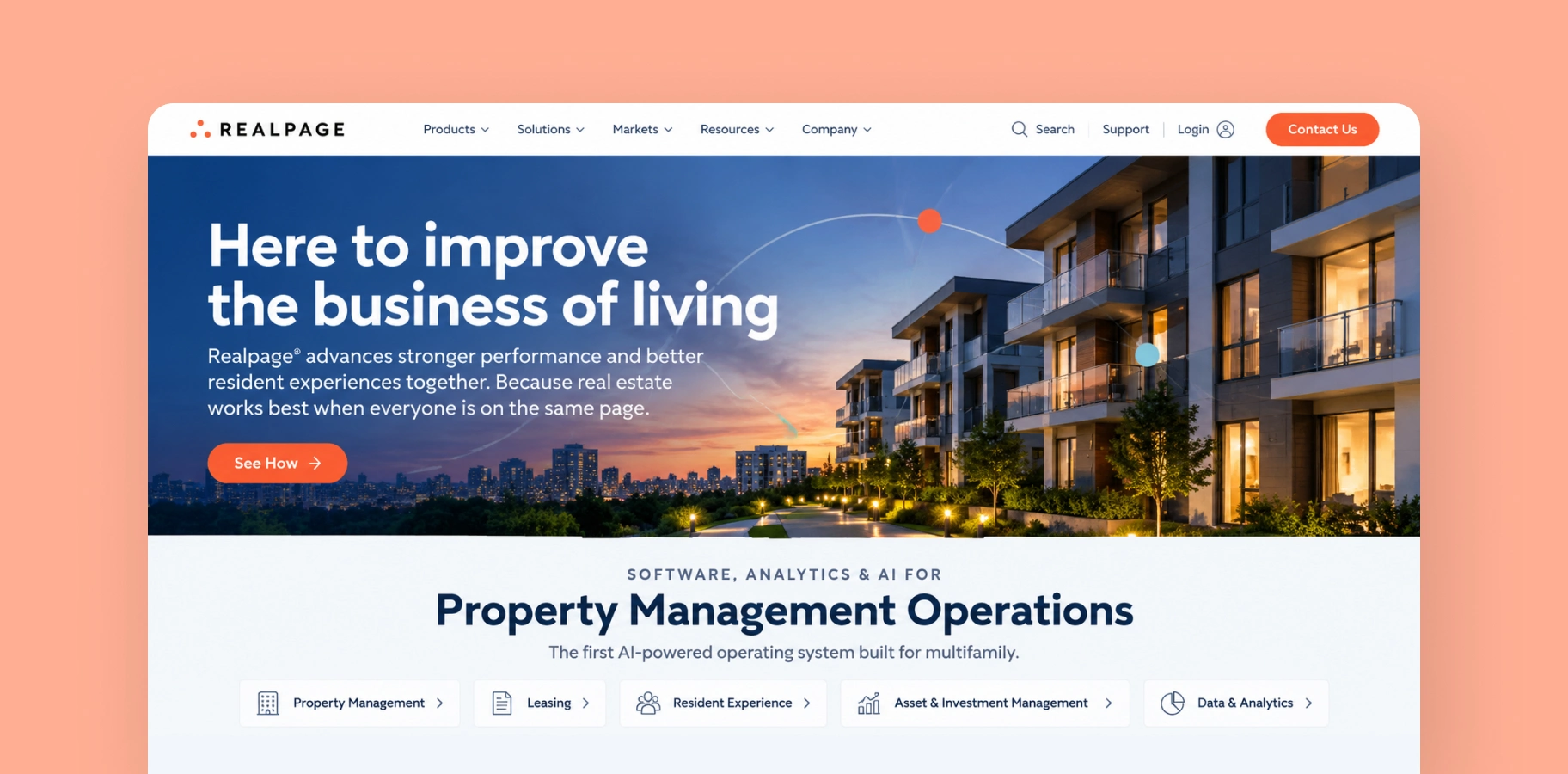
2. RealPage
Provider type: ready-made real estate software platform.
RealPage is suitable for companies that want to use established investment accounting and portfolio management capabilities rather than building the corresponding modules from scratch.
RealPage Investment Accounting is designed for organizations that manage real estate investment holdings. The platform supports multiple asset classes, including commercial, multifamily, hospitality, single-family, senior living, and affordable housing.
Its core features include partnership accounting, capital calls, distributions, management fees, and waterfall distributions, as well as corporate accounting and consolidated financial statements. RealPage also integrates Investment Accounting with Portfolio Asset Management to collect, analyze, and report on portfolio data.
Integrations: It is important for a potential client to verify compatibility with their current property accounting and other software stack during vendor evaluation.
Best fit: real estate investment organizations that need out-of-the-box accounting and portfolio management capabilities and whose processes align well enough with RealPage’s product model.
Considerations: Before implementing the platform into your processes, assess how well the standard workflows, integration options, and configuration capabilities align with your company’s internal processes.
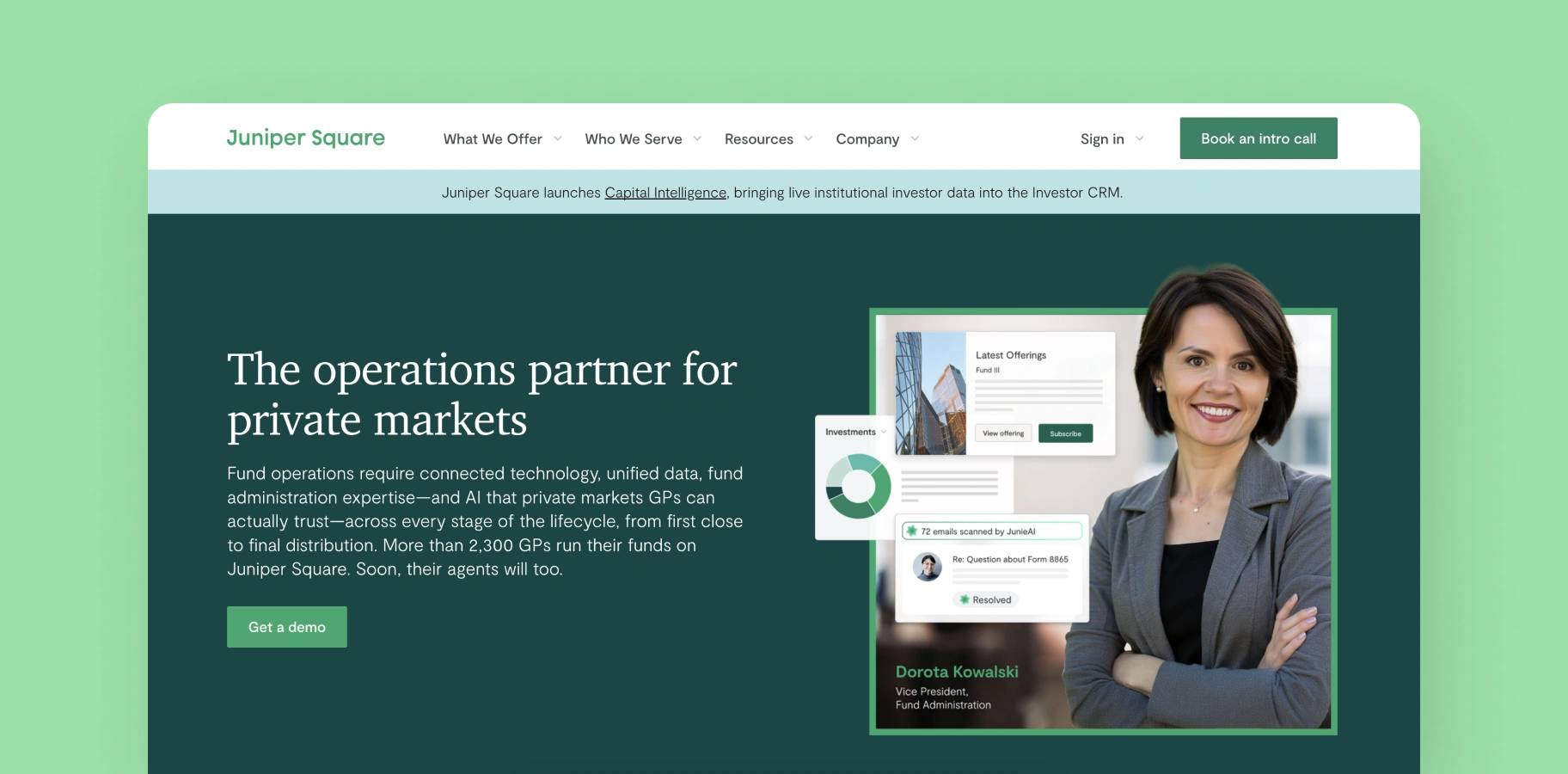
3. Juniper Square
Provider type: a turnkey private markets platform.
Juniper Square is suitable for real estate investment managers who need a centralized system for fund operations, investor management, capital activity, and reporting.
Juniper Square positions GPX as a fund operating system for private markets. The platform integrates investor relationships, fundraising, fund accounting, treasury, compliance, and reporting, and supports real estate alongside other asset classes.
For portfolio and fund analysis, the system allows users to calculate IRR, multiples, distributions, and custom KPIs. Capital activity includes capital calls, distributions, fees, and investor equity. A distinct feature is investor waterfalls. Juniper Square supports automated waterfall calculations and allocations, including preferred returns, GP catch-up, carry, and custom tiers.
Integrations: The platform features a developer API and allows for the import and export of fund and asset data in standard formats.
Best fit: real estate GPs and investment managers for whom investor operations, fund accounting, and capital management are core processes.
Considerations: Juniper Square is best viewed as a complementary platform rather than a direct replacement for an operational property management system (PMS). If a business requires tenant, maintenance, or other property-level workflows, a separate PMS must be selected, and the method of data exchange between the systems must be defined.
4. Inoxoft
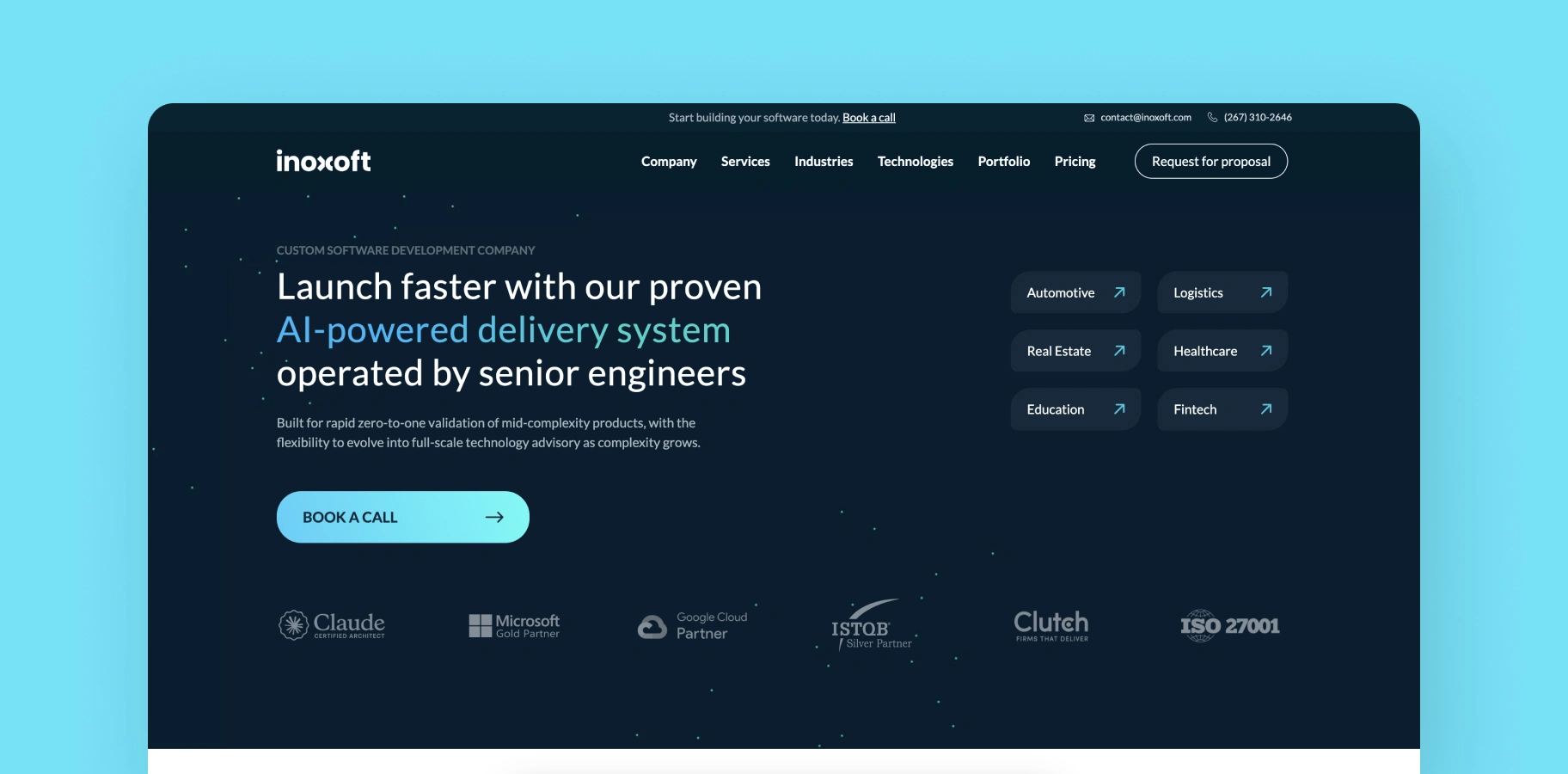
Provider type: custom software development company.
Inoxoft is a good fit for real estate businesses that need their own property or investment management platform with custom workflows and integrations.
The team has delivered 35+ platforms for enterprise and mid-size real estate businesses, offers custom platform development, and creates systems tailored to business-specific property workflows. The company also claims ISO 27001 certification in the context of its real estate development expertise.
A separate division of the company focuses on real estate investors. Inoxoft has completed over 35 real estate projects and has more than 10 years of experience in PropTech, positioning its solutions as a way to transform fragmented property data into portfolio insights.
Integrations: 90% of its property management projects are integrated with CRM, ERP, MLS, and payment systems.
Best fit: Property managers, real estate investors, and PropTech businesses that need a custom system or to modernize existing software, and for whom standard SaaS does not provide the necessary flexibility.
Considerations: Performance figures such as project volume and integration rates come from Inoxoft’s own reporting. Evaluate them alongside practical evidence, including case studies, client references, architecture, scope, pricing, IP terms, and support arrangements.
5. Cdatalabs (Constellation Data Labs)
Provider type: real estate data and API provider.
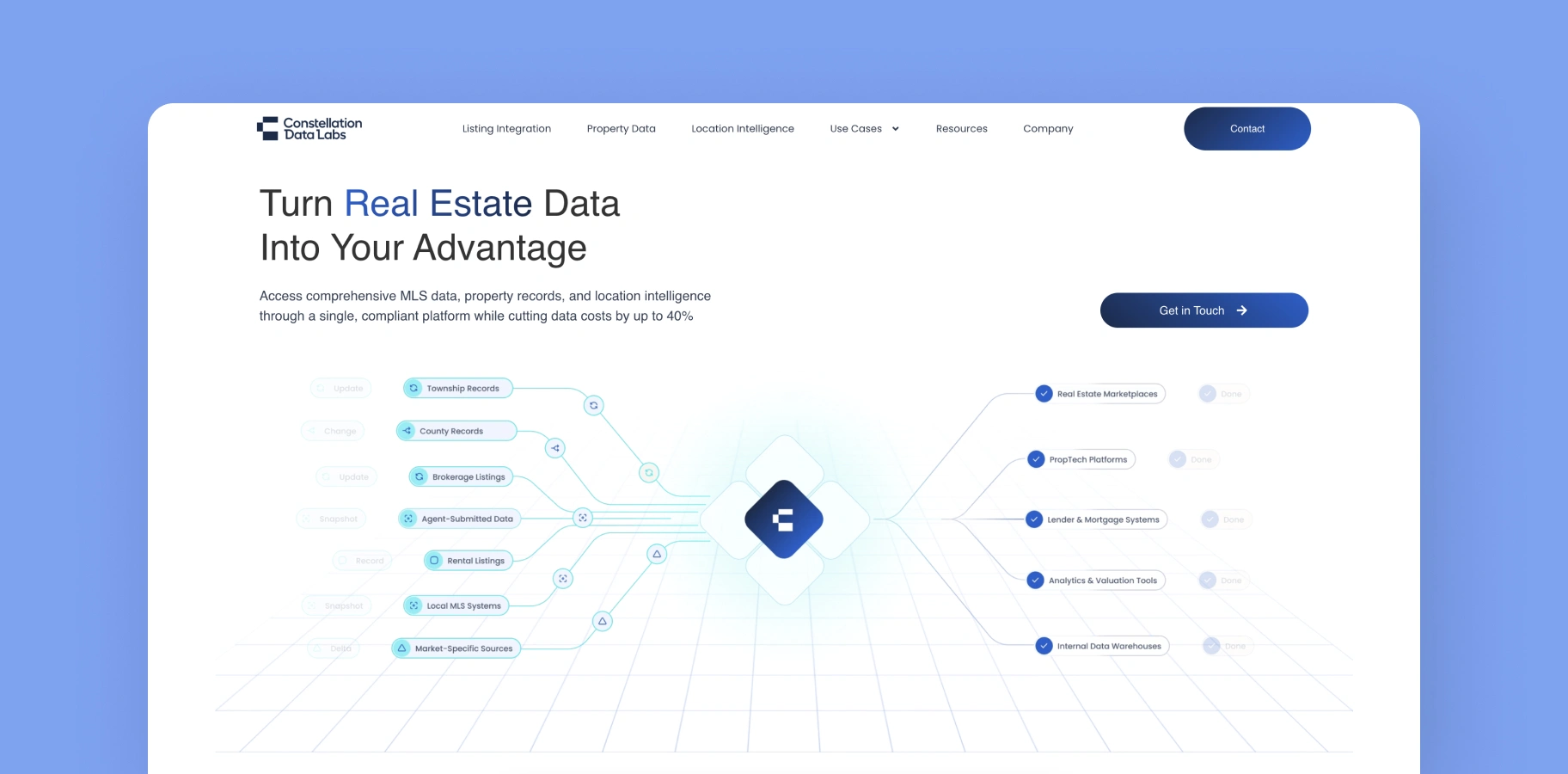
Constellation Data Labs provides a data infrastructure that can be integrated into a company’s own or a third-party product. This is what sets the company apart from other providers on the list.
Constellation Data Labs provides MLS listing data, property records, and location intelligence. Its property dataset covers over 160 million properties across 3,143 U.S. counties and includes property characteristics, ownership records, transaction history, valuations, taxes, mortgage information, geocodes, and other data categories.
For asset management and PropTech, this can serve as an external data layer for portfolio analytics, valuation, property intelligence, or other custom functions.
Integrations: The company offers GraphQL APIs, REST/OData with RESO Web API support, webhooks, SFTP/S3, database replication, and custom ETL pipelines. The company also applies RESO Data Dictionary standards to normalize listing data.
Best fit: PropTech companies, brokerages, lenders, asset managers, and enterprise real estate technology teams that need external, standardized property or listing data for their own applications.
Considerations: The data provider does not automatically create workflows, dashboards, or investment logic. So, businesses still need an application layer to utilize this data.
Conclusion
Choosing the right real estate asset management software provider starts with understanding what you actually need: a ready-made platform, a custom system, or external data connected to your existing product.
RealPage and Juniper Square offer established platforms that can work well when their functionality already fits your core processes.
Constellation Data Labs covers a different part of the stack, providing property, listing, and location data that can support either a SaaS or custom solution.
TRIARE and Inoxoft focus on custom development, which makes more sense when you need multiple integrations, proprietary logic, custom dashboards, or workflows that standard SaaS products don’t support.
So don’t compare providers by features or initial price alone. Look at implementation time, recurring costs, integrations, migration, security, scalability, ownership, and post-launch support.
Not sure whether to buy, integrate, or build? TRIARE can help you assess your current setup and choose the right technical path for your business.