How Property Management Software Can Reduce Support Costs by 40%
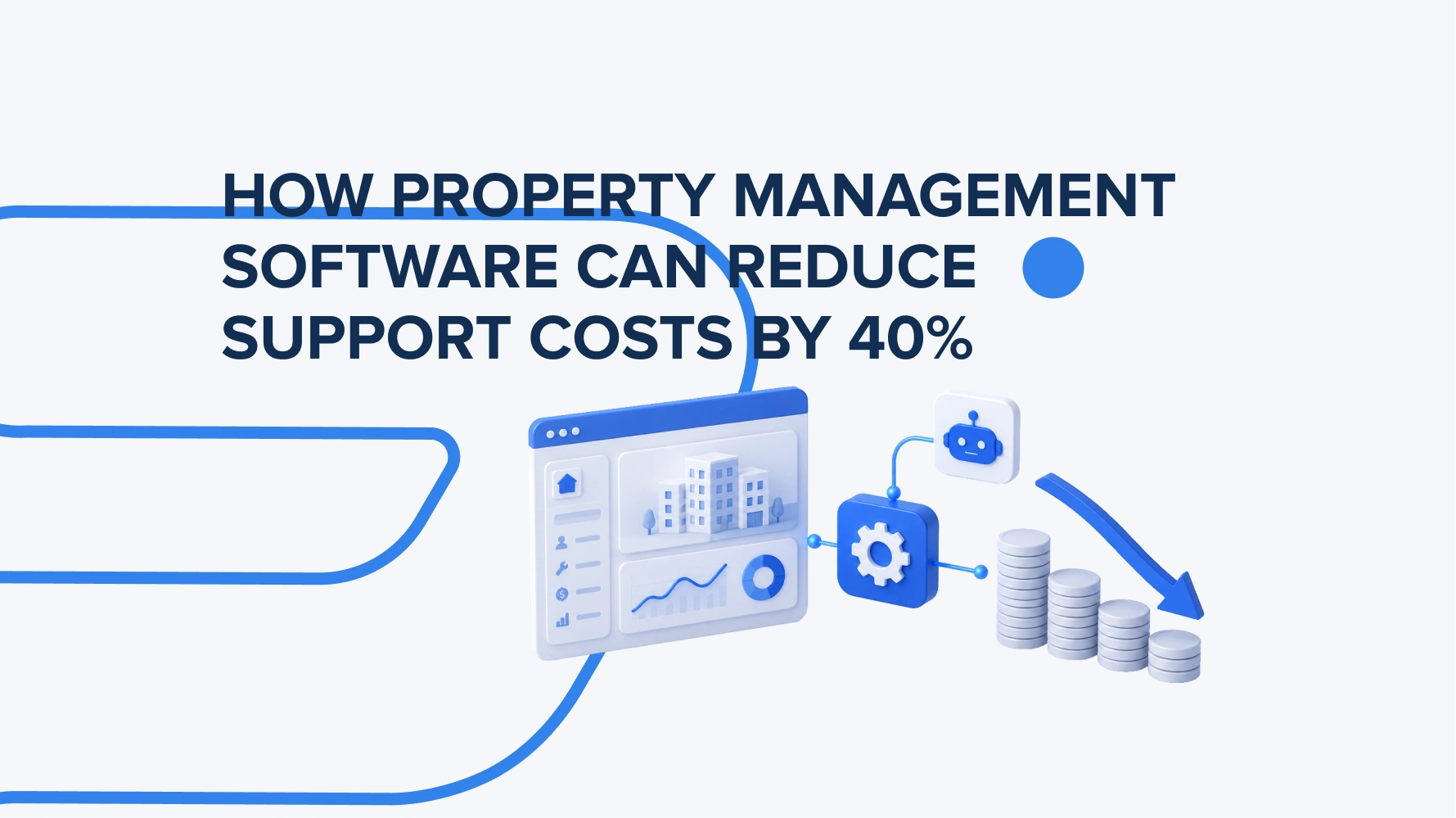
As property portfolios grow, so do support requests, manual tasks, and operational complexity. Property management software helps companies automate repetitive processes, improve data accessibility, and reduce administrative workload. In this article, we’ll explore which features deliver the greatest impact, when custom software makes sense, and how to approach automation strategically.
Why are support costs so high in property management?
Property management support costs are high because most requests require coordination between multiple people, systems, and approvals rather than a single action.
Support costs in property management reflect how much more complex the business has become. In today’s conditions, managers work with landlords, tenants, contractors, insurance companies, and municipal services at the same time. More responsibilities – more work and, accordingly, expenses to support new workflows that come with changes in the industry.
As the Buildium reports state, 56% of owners cite support and technical maintenance as the main reason why they come to property management services. A property manager acts as a bridge between landlords and tenants, taking care of everything from marketing, rent collection, repairs, and inspections.
“Maintenance support is the main reason owners hire a property manager.” – Buildium, 2026 Property Management Industry Report.
Since property management covers a wide list of services (daily operations, maintenance, tenant relations, finances, and legal compliance), there is a complex system, interconnected by workflows, tasks, and inquiries.
Here’s an example of how complex even a single maintenance request can be. When a tenant reports an issue with the property, the property manager typically receives the request, agrees on a budget with the owner, finds a contractor, manages the financial records, and verifies that everything has been completed to the expected standard. This requires time and money, especially if everything is performed manually, without an automated internal system.
An interesting fact is that even the AI implementation doesn’t yet mean full property management system automation. The same Buildium company reports that AI adoption among property management companies rose from 20% in 2024 to 58% in 2025, yet only 8% of companies have fully automated at least one business process. Clearly, the biggest challenge isn’t a lack of tools, but integrating technology into actual operations.
What does property management software automate?
Up-to-date real estate management software automates end-to-end operational processes that previously required multiple people to handle. Before, managers manually created a simple repair request or sent a notification to tenants to remind them about the rental payment date. Now, the system performs these tasks faster, taking into account the large-scale business logic.
It doesn’t just perform an action, but automatically updates the next steps in the process. This shift from automating individual tasks to automating whole business processes has become a key area for development in the industry.
The property management software also touches the most important real estate business area – financial operations. It automates invoicing, processing rent payments, calculating late fees, preparing financial reports for owners, tracking maintenance costs, and integrating with accounting systems. As an outcome, the two greatest impacts – less manual work and faster task completion, especially when there is a large base of landlords and tenants who require attention day to day.
Talking about property owners on different levels, the communication with them can also be automated within a single software. Companies are increasingly using AI to handle initial inquiries, classify requests, search for information in a knowledge base, and route complex cases to the appropriate specialist. It lets employees focus on situations where they’re truly needed and shortens the time for task completion.
In the table below, we combined the main business processes that can be automated and what exactly can be improved.
|
Business process |
How property management software automates it |
| Maintenance management | Service request intake, work order creation, vendor assignment, approval workflows, status tracking, and completion verification. |
| Rent collection | Invoice generation, recurring payments, payment reminders, late fee calculation, and receipt issuance. |
| Lease management | Lease renewals, document generation, e-signatures, expiration reminders, and compliance tracking. |
| Tenant communication | Automated notifications, self-service portals, AI-powered responses to common inquiries, and request routing. |
| Owner reporting | Financial reports, occupancy updates, maintenance summaries, and investment performance dashboards. |
| Accounting & finance | Payment reconciliation, expense tracking, invoice processing, tax reporting, and accounting system synchronization. |
| Vendor management | Contractor onboarding, job assignment, performance tracking, invoice approval, and payment processing. |
| Inspections & compliance | Inspection scheduling, digital checklists, photo documentation, compliance reminders, and audit trails. |
How can a tenant portal reduce support tickets?
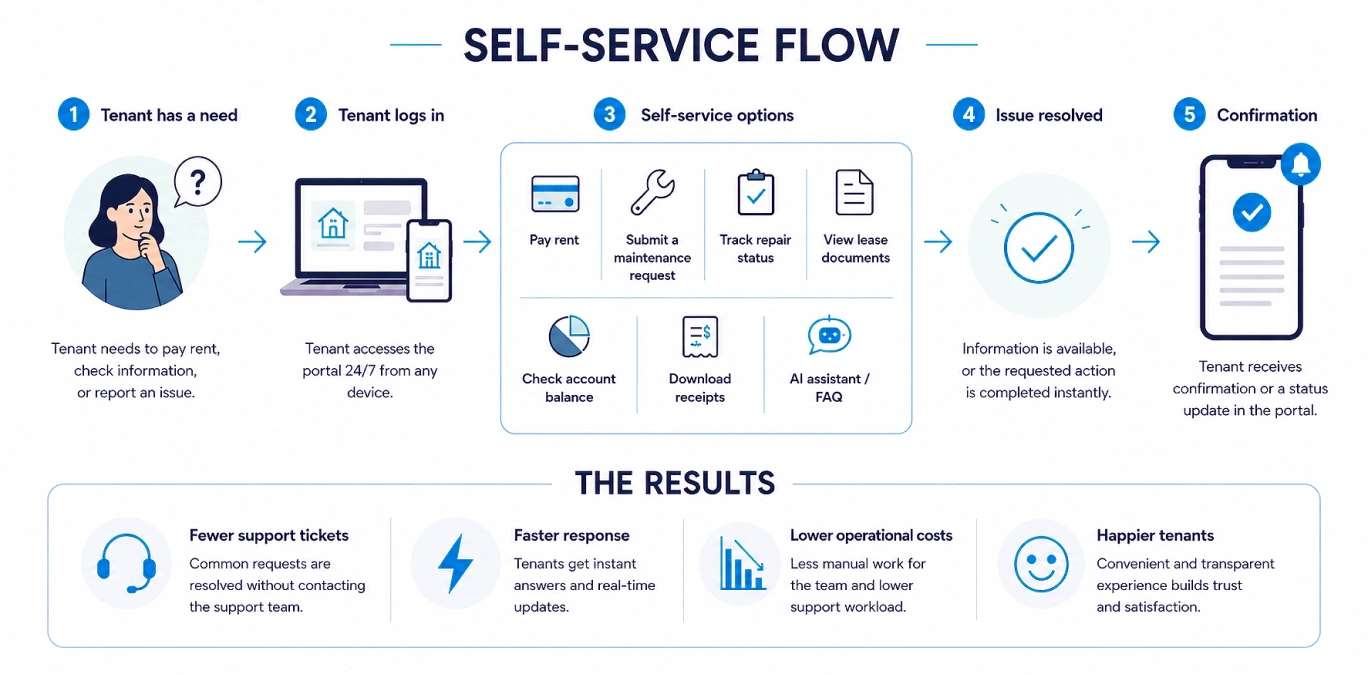
A tenant portal transforms inquiries from property owners to managers into a self-service format. The logic is simple: there is no need to disturb the property managers with specific questions, and resolve them by themselves. For example, pay rent, review the lease agreement, check the status of a repair request, view the payment history, or download the necessary documents.
The biggest impact comes not from decreasing the number of inquiries to service, but from the part when some requests are not created at all. Besides, most support tickets (from real property managers’ experience) do not request the resolution of important issues. In most cases, there is a wave of repetitive questions – “Did you receive my payment?”, “When will the service arrive?”, “Where can I find the contract?” A tenant portal eliminates all possible questions, since tenants monitor all actions and track the completion of tasks on their own.
According to Gartner:
“…only about 14% of customers fully resolve their issues through self-service today…” – Gartner, Self-Service Customer Service Report.
This clearly shows that the potential of tenant portals lies not simply in their existence, but in how well they are integrated with business processes and enable users to perform the necessary actions on their own. Now and in the future, self-service portals will help scale services without hiring more people for every increase in workload.
How does maintenance request automation reduce manual work?
Maintenance request automation within a property management system handles most routine administrative tasks automatically, with little or no staff involvement. According to real cases, a tenant can submit a request through the portal, and the system takes care of the entire task. The software automatically determines the issue category, sets its priority, forwards the request to the responsible property manager or contractor, sends notifications about status changes, and stores the communication history in one place.
It cuts a significant amount of time to do this manually for every tenant request. We can confidently state that automation brings better productivity through faster task completion and forms trust from the property owners as they get a better service experience.
According to Gartner:
“…AI is already reducing contact volumes and improving agent efficiency, prompting 85% of service leaders to expand employees’ responsibilities toward higher-value work rather than repetitive manual tasks.” – Gartner, 2026 Survey.
The bottom line is, automation reduces manual work by eliminating repetitive administrative tasks, allowing support teams to focus on exception handling and higher-value activities instead of routine request processing.

How does TRIARE approach property management software development?
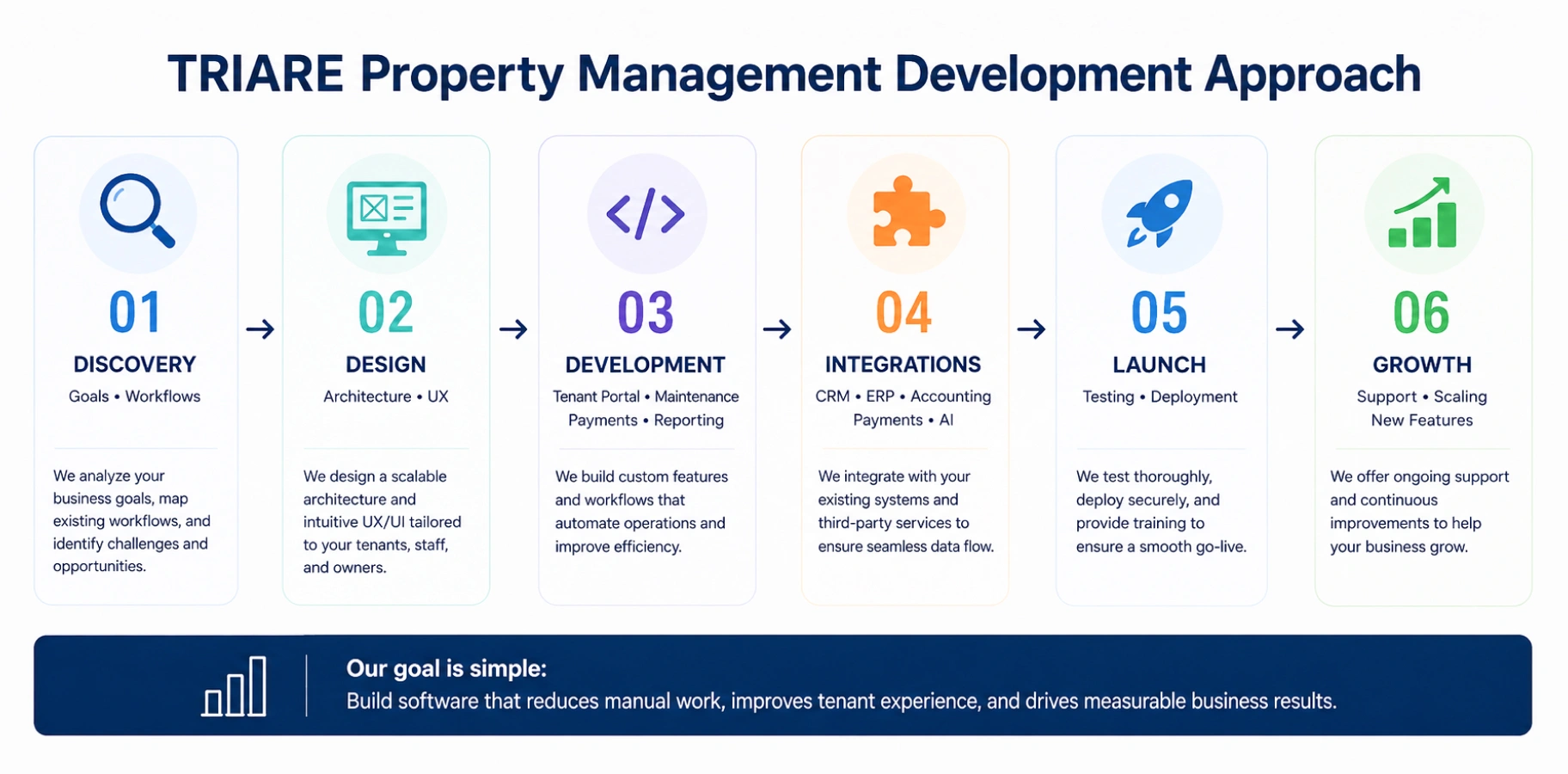
We always look at software solutions as a complex system that solves every issue that the client typically faces. We don’t see client challenges as standalone features. We treat them as part of a larger system, making sure every solution strengthens the overall product.
Thus, the first step we take is analysing how the company handles tenant inquiries, coordinates maintenance, processes payments, and interacts with property owners. In other words, how everything works inside the company.
Then we identify hot spots in processes that slow things down and must be improved or removed first. We explain what processes must be automated, what outcomes to expect, and what systems need to integrate to bring greater business effect in the long run. From our team’s experience, this applies to workflows for maintenance requests, tenant portals, financial transactions, notifications, document management, and reporting.
We create solutions that easily integrate with CRM, ERP, accounting platforms, payment services, electronic signature systems, and other tools your company already uses. As a result, all participants in the process can exchange information seamlessly, minimizing data duplication and manual work.
If needed, or if the system requires this to bring better results, we also integrate AI into existing commercial property management software. It touches on intelligent routing of requests and automatic classification of inquiries to AI assistants for tenant portals.
Our goal is to create software that scales with your business, automates routine processes, and helps property management companies improve efficiency without driving up operating costs.
How did TRIARE improve real estate operations in the Arctic case?
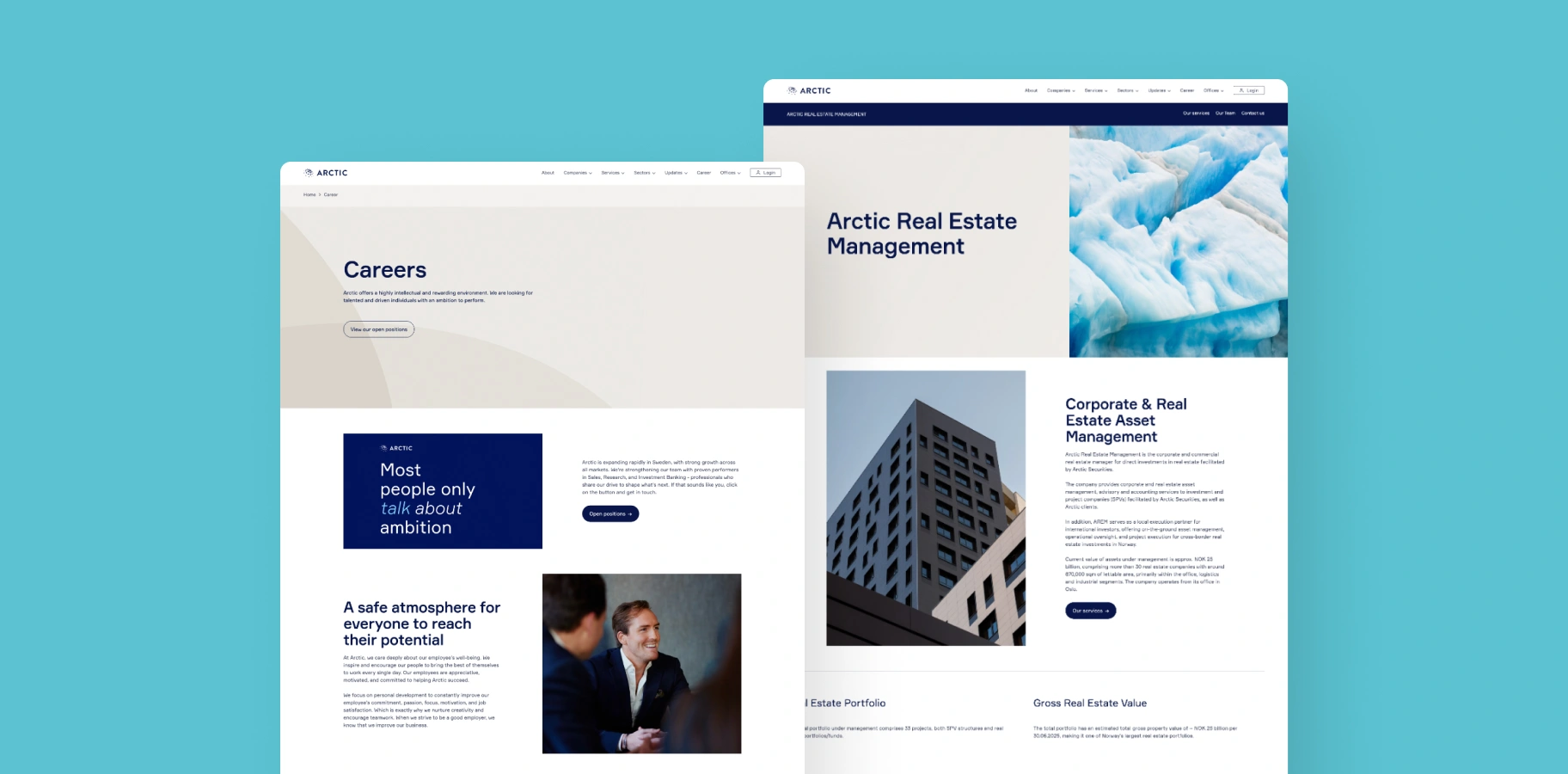
The Arctic – Real Estate Management System project is a real case that proves how improving the existing platform can significantly increase operational efficiency without completely replacing existing software.
The TRIARE team focused on analyzing the business processes that had the greatest impact on users’ daily work and gradually optimized them based on feedback that business managers provide after daily system use.
The biggest challenge at the start was process fragmentation. That is what complicated investment project management, compromised data quality, and slowed down decision-making. To address this, TRIARE experts optimized key business processes performance, revised logic governing interactions between system modules, and improved processing of large volumes of data.
Special attention was paid to optimizing daily workflows. The team not only implemented the client’s requests but also analyzed system usage scenarios to identify unnecessary steps, simplify users’ tasks, and make business processes more consistent. Furthermore, data validation mechanisms were implemented as well, which improved data quality and helped managers make decisions with more confidence.
Let’s see what key improvements our team made for the Arctic project:
– optimization of the process for creating and configuring real estate projects;
– improved calculation formulas for more accurate financial modeling;
– enhanced integrations with third-party services for reliable data synchronization;
– an updated dashboard for centralized management of the real estate portfolio;
– data quality verification tools have been implemented;
– core workflows and the user interface have been optimized.
Faster data processing, improved business processes, and positive user feedback confirmed that small but targeted improvements to an existing system can create real operational value without a full rebuild.
How did TRIARE improve data quality and reporting for Arctic?
To improve data quality for Arctic, the TRIARE team streamlined the processes for entering and verifying information, improved the business logic behind calculations, and enhanced integration performance. These updates help ensure that property and project information remains consistent, accurate, and synchronized throughout the system.
For reporting, we transformed existing logic with fragmented information from many different sources into a centralized data hub. The updated approach provides a more transparent view of project statuses, facility characteristics, and key metrics for decision-making.
These changes make the Arctic system a more reliable foundation for operational management. The Arctic team gained faster access to up-to-date information, reduced the number of manual checks, and is able to make decisions based on higher-quality data.
How can AI-powered property management planning reduce repetitive questions?
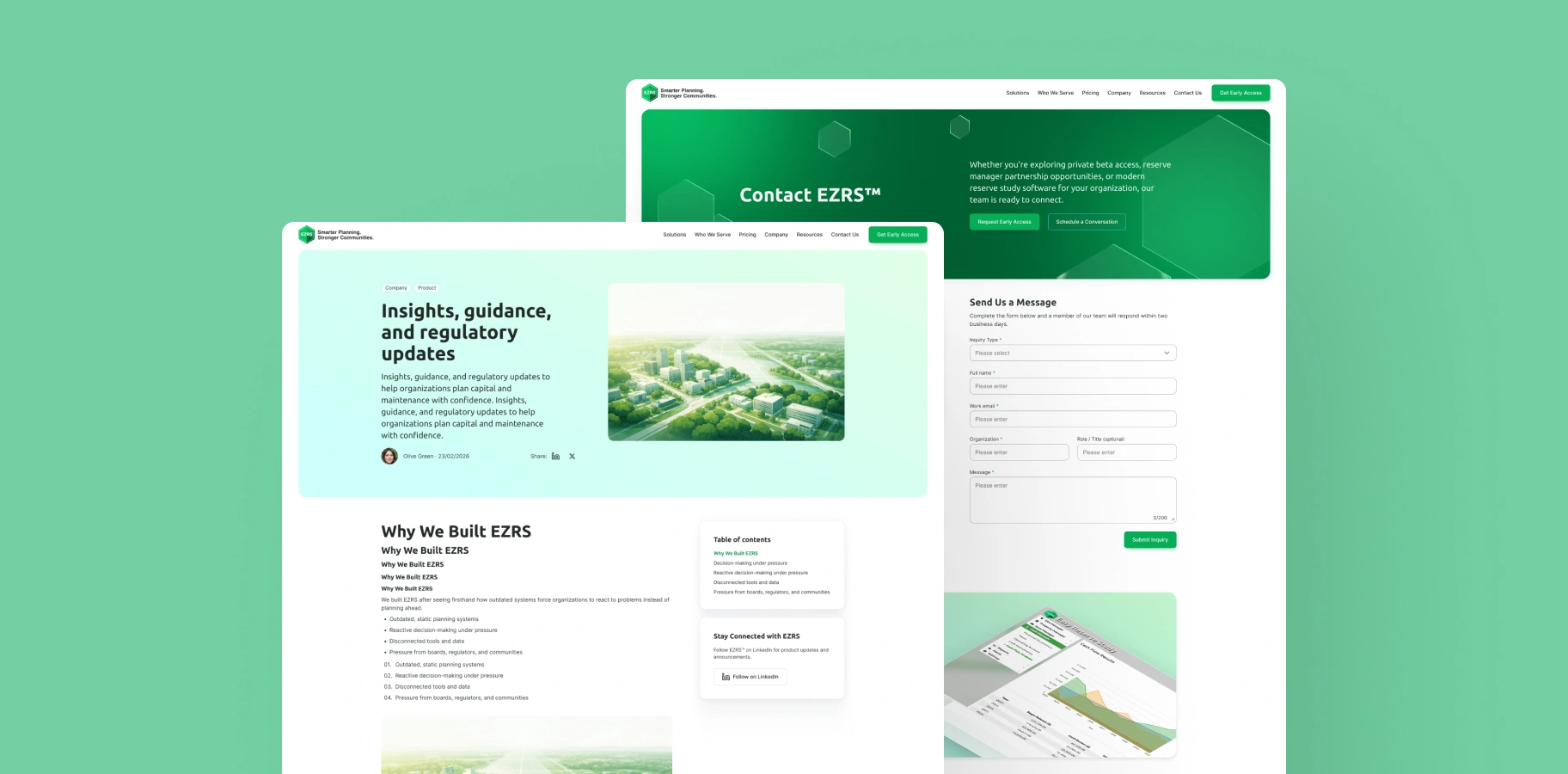
We’ll use the EZRS case we delivered recently as an example to explain this question. EZRS is a digital platform for backup planning and real estate asset management. The system helps companies store property data in a single environment, forecast future expenses, and plan maintenance more effectively.
The AI approach here isn’t limited to generating responses. Its core value lies in a structured data hub with AI support that is available for anyone looking for answers, without involving a property manager.
In practice, an AI-powered system replaces numerous questions like “What expenses are expected in the coming years?”, “Why does this facility need repairs right now?”, “What impact will postponing the work have?” Instead, users get answers directly from the system based on up-to-date data on assets, maintenance history, and long-term plans.
Looking at EZRS, the platform was created to facilitate the transition from static tables and manual analysis to more centralized data management. It helps organize information about assets, estimate future costs, and prioritize repairs.
For property management, this means less manual communication between owners, managers, and contractors. Instead of gathering information from various sources every time it’s needed, the team has a single source of truth to see a property’s current status and what needs attention next.
At the same time, it’s important to note that AI in such solutions does not replace real estate management experts. It’s designed to reduce the administrative burden: automate information retrieval, assist with scenario analysis, and make planning more transparent.
This is precisely the approach EZRS uses to support professional contingency planning within property management programs. The key insight to note is that technology helps specialists make decisions rather than replacing them.
Which features help property management software cut support costs by 40%?
A 40% reduction in support costs is a realistic target rather than a guaranteed outcome. Actual results depend on factors such as the current level of manual work, portfolio size, tenant request volume, data quality, process maturity, and the overall scope of automation.
The greatest impact is usually achieved when property management software combines automation, centralized data management, and intelligent information search within a single system.
In this table, we’ve combined the main features that help reduce support costs by up to 40%.
|
Feature |
How it helps reduce support costs |
| AI-powered property search | Enables teams to instantly find property records, maintenance history, documents, and project information instead of searching through multiple systems. |
| Centralized property database | Keeps all departments working with the same up-to-date information, reducing duplicate requests and errors caused by inconsistent data. |
| Self-service tenant and owner portal | Allows users to check request statuses, access documents, and find property information without contacting the support team. |
| Workflow automation | Automatically assigns tasks, updates statuses, sends notifications, and routes requests to the right team, reducing manual coordination. |
| AI assistant for property management | Provides instant answers to common questions about assets, maintenance schedules, budgets, and property plans using centralized data. |
| CRM, ERP, and accounting integrations | Synchronizes data across business systems, eliminating duplicate data entry and reducing support requests caused by inconsistent records. |
| Real-time dashboards and reporting | Gives managers immediate access to operational and portfolio insights without preparing reports manually or requesting information from other departments. |
How should a property management company start automation with TRIARE?
You may not have a strict list of features that must be implemented or technical requirements for software you have or those that must be created from scratch. What is really important is to understand what business issues you want to resolve first with the software. Where you waste time and opportunities, and what weak sides must be improved to bring the benefits you expect to get.
This short questionnaire helps you understand what’s happening in your business today and where there’s room for improvement.
– What processes are still performed manually and how much time they take for the team?
– The most frequently requests in customer support or among employees.
– Where is the data currently stored – in a CRM, ERP, Excel, accounting system, or several separate services?
– Which processes most often lead to errors due to duplicate information or a lack of up-to-date data?
– What business results does the company expect from automation: to reduce operating costs, speed up the team’s work, improve service quality, or gain more transparent analytics?
It’s also helpful to identify in advance which systems are already in use and which ones need to be integrated. In most cases, companies don’t need to abandon their existing CRM, ERP, or accounting software. These can be integrated into a single ecosystem.
It’s easier for a business to build a solution that delivers measurable business value when it clearly understands its operational challenges and desired outcomes.
When should you build custom property management software instead of using off-the-shelf tools?
Off-the-shelf platforms are well-suited for companies with standard processes and typical requirements. With them, you get started quickly, but as your business grows, there may be limitations in integrations, automation, and scalability.
Developing custom property management software becomes a viable option if your business faces one or more of the following situations:
|
Situation |
Why custom property management software is the better choice |
| You rely on multiple disconnected systems | A custom platform integrates CRM, ERP, accounting software, document management, and other business tools into a single ecosystem. |
| Your team spends too much time on manual work | Workflow automation reduces repetitive tasks, manual approvals, data entry, and report preparation. |
| Off-the-shelf software cannot support your workflows | Custom software is designed around your business processes instead of forcing your team to adapt to predefined features. |
| You need AI-powered capabilities | Custom development makes it possible to implement AI-powered search, predictive maintenance planning, intelligent reporting, portfolio analytics, or other business-specific AI features. |
| You manage a large or growing property portfolio | A custom solution can scale with your business while maintaining performance, security, and flexibility. |
| Your business has unique operational requirements | Custom software supports specialized approval workflows, financial models, property planning processes, and other requirements that standard platforms cannot accommodate. |
Custom software is also a sound choice if you plan to gradually implement AI and automation. In this case, new features can be developed alongside the business, integrating them into existing processes without the limitations typical of off-the-shelf platforms.
Conclusion
Property management software delivers the greatest business value when it solves operational challenges rather than simply adding new features. By combining automation, AI, system integrations, and reliable data management, companies can reduce administrative overhead, improve decision-making, and build a scalable foundation for future growth. The right solution is the one that fits your business, not the other way around.