Real Use Cases of Headless CMS Across Industries with Expert Insights
Content management is the key to keeping your digital presence organized and always being ready to deliver the right message to your audience. In this article, you’ll learn how Headless CMS helps businesses across different industries achieve real results.
What is Headless CMS, and how does it work?
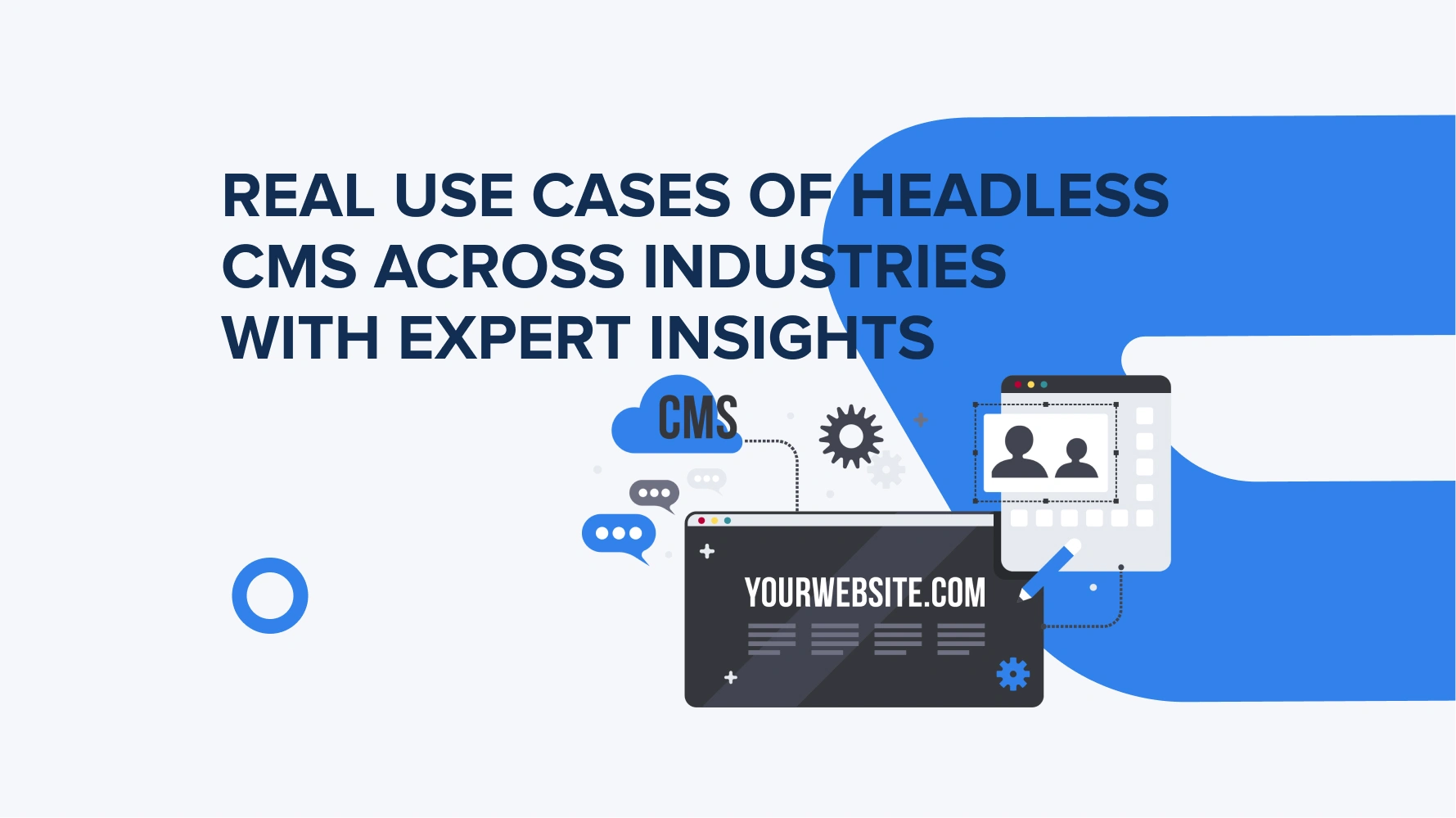
Headless CMS is a content management system where the frontend and backend are separated from each other. What does this mean and how does it work? Let’s say you have your own e-commerce website and you need to constantly update its content. Product cards, descriptions, images, add new products, etc. Plus, you have a mobile app as a part of the same ecosystem as your website.
Now, instead of updating everything twice, a custom Headless CMS gives you a single admin panel where you manage all content. You make changes once, and they instantly appear on both platforms. This is because the frontend (your server part with the admin panel) is separated from the frontend (visual information display).
Advantages of this approach:
- Content can be used on websites, mobile apps, wearable devices, etc.
- Developers are flexible in their choice of any framework. They can use React, Vue, Svelte, and other technologies.
- Content can be published once on multiple platforms without extra work.
- Content managers work in the admin panel independently of developers.
- Most Headless CMS SaaS solutions include automatic scaling, backups, and protection by default.
Why do companies switch from traditional CMS to Headless?
First, companies want to reach wider audiences across multiple platforms. Headless CMS makes this possible by centrally storing content and delivering it via API to all platforms at once. There’s no need to duplicate content, waste team time, or manage multiple separate environments. Having this feature saves time, which is a key resource for large companies.
Another big advantage is that content managers no longer depend on developers. Managers can update content through an intuitive admin panel, while developers focus on server-side tasks. This separation simplifies workflows and speeds up work for all departments. There is also no need to learn the team how to use the admin dashboard. It’s easy to use for everyone without a tech background.
Developers also have full freedom with Headless CMS. They aren’t tied to templates or internal CMS mechanisms and can use modern frameworks like React or Vue. Businesses can get unique, dynamic interfaces that attract users and meet their expectations with this flexibility.
As a rule, traditional CMS platforms generate the entire page, including both frontend and backend parts. This approach significantly slows down loading times, especially under high traffic. Headless CMS, on the other hand, sends only the necessary data from the admin panel, and the website or app displays it. The result: faster-loading pages, better user experience, and improved SEO rankings.
Security is another key benefit. With the frontend separated, CMS servers are less exposed to vulnerabilities common in traditional CMS platforms with many plugins. Headless CMS reduces the risk of cyberattacks and prioritizes data protection.
Finally, separating the backend and frontend makes it easy to adapt to new trends without changing the CMS itself. Developers can use trendy and workable technologies, while managers can realize any content ideas as well. The system is future-proof and ready to evolve alongside your business needs.
How is Headless CMS used in e-commerce?
Headless CMS in e-commerce it’s a smart assistant for streamlining content management and making it effortless to handle all the data your store collects. Especially taking into account the vast amount of data that e-commerce websites contain. This way, you make changes once and all the data you need is published on all the e-commerce platforms you have (website, mobile app, etc.). It covers changes in item cards, images, descriptions, adding new special offers to clients or new products, etc.
With a Headless CMS, e-commerce businesses can easily add new marketing and sales channels or integrate with other systems to improve essential business processes. So, it’s something bigger than just working with content. One admin panel helps you manage all the core business sides – sales, content, and marketing.

How is Headless CMS used in modern media and publishing?
Headless CMS in media works on the same principle as for other platforms. It separates content storage and processing from its display. Technically, content is delivered via API, which speeds up loading and playback of multimedia, improving both user experience and SEO. Editors can publish and update materials independently, without constant developer involvement, reducing the time it takes for news and multimedia to reach the audience.
The key difference is in the following. Content managers focus on industry-specific content and distribute it across multiple networks and devices. Articles, videos, podcasts, and other interactive materials. It ensures a unified experience for users across all platforms and simplifies content managers’ jobs.
For publishing and media businesses, developers can create unique interfaces tailored to different types of content. Whatever is uploaded will be presented in a modern, engaging, and interactive way that appeals to readers.
It’s also easy to add new content formats or integrate analytics, advertising, and external services without rebuilding the CMS. This provides full adaptability for new types of content or integration with other services, helping businesses achieve their goals efficiently.
How do healthcare organizations use Headless CMS?
Here are the most common Headless CMS use cases in healthcare organizations.
- Headless CMS helps to create and deliver personalized content to patients through multiple channels. For medical purposes, there are websites, mobile apps, and e-mails. It’s an easy way to provide patients with up-to-date information, treatment recommendations, and reminders.
- Headless CMS lets medical organizations build multilingual platforms so patients can get medical information in their native language. As a result, patients from diverse cultural backgrounds have better access to healthcare services.
- Also, medical organizations use Headless CMS to manage marketing campaigns. For instance, on landing pages, blogs, and newsletters, to help attract new patients. So managers can change marketing strategies anytime, just by making a few changes on the frontend side.
How do financial institutions use Headless CMS to ensure security and flexibility?
Separating the backend and frontend reduces the risk of attacks on the user interface and keeps data in a secure environment. In other words, when there are two environments where all content is stored and edited, it’s more difficult to influence it.
Financial institutions can implement the following security measures directly within a Headless CMS:
- modular architecture,
- access control,
- data encryption,
- SSL certificates,
- support for GDPR and PCI-DSS standards,
- integration with multi-factor authentication,
- secure protocols that provide an extra layer of protection.
Headless CMS also provides financial institutions with great flexibility. Thanks to the API, content can be delivered to websites, mobile apps, and other platforms, providing a unified experience for users. Whatever you need – on a website, additional online platforms, blogs, mobile apps, and others.
The scalability and flexibility that Headless CMS gives financial institutions allow them to add new channels or integrations without rewriting code. Dev teams just add required actions through the built-in features, add the options you need, and that’s all. Support for modern technologies like React or Vue.js enables the creation of interactive and responsive interfaces. That means that you can realize all the ideas you need to meet users’ needs and achieve business goals.

Technical benefits of the Headless CMS implementation process
Here are the key benefits that you can get after Headless CMS implementation.
Flexibility in choosing technologies
With a Headless CMS, the tech team can create an attractive user interface using any modern framework and technology. This way, they can build interactive websites or mobile apps without the traditional CMS platform’s limitations.
Improved performance
By delivering content via APIs, Headless CMS helps optimize web pages, reducing their size and loading time for faster, smoother user experiences. Page load speed increases and user satisfaction as well.
Easy scalability and adaptability
Since content is delivered through APIs, it can be seamlessly integrated with multiple devices and platforms, making it easy to scale and adopt new technologies.
Enhanced security
Separating the backend from the frontend reduces the risk of cyberattacks. It’s because administrative interfaces are not directly accessible through the public website. Multi-factor authentication and data encryption can also be implemented within a Headless CMS. By looking at popular Headless CMS examples, businesses can clearly understand how to improve security for every user.
Seamless integrations
Thanks to its API-oriented architecture, Headless CMS lets you easily integrate your platforms with various third-party services. That’s a big deal in terms of creating complex digital ecosystems.

What are the most common technical problems when implementing Headless CMS?
There are not many of them, but still, it’s important to know what challenges you may face.
Integrating a Headless CMS with third-party services can be tricky. API incompatibility or limited integration options may cause malfunctions or content delivery issues. The solution lies in careful planning: using standardized APIs, well-documented integration services, and testing each step in advance.
APIs for content delivery may also impact performance. Under high loads, misconfigured or excessive requests can slow down page loading. This can be addressed by optimizing API requests, implementing caching, and using a CDN for faster delivery.
Security is another critical aspect. Weak API security, lack of encryption, or missing multi-factor authentication can add some risks. How to solve them? Maintaining compliance with standards like GDPR, PCI-DSS, OWASP, and regular access audits helps keep user data safe.
As you can see, every case can be solved with the right technical partner. TRIARE experts have more than 10 years of experience working with Headless CMS systems, so we are ready for any scenario that may arise during development.

What real results have companies achieved by implementing Headless CMS?
There are examples we’d like to share to show how Headless CMS helps different businesses achieve the best results.
Well-known Nike actively uses React / Node.js technologies and has transitioned to Headless commerce to sell sports goods worldwide. As a result, mobile conversion increased by 50%. Product content and updates are delivered instantly, enhanced with interactive elements that stimulate purchases. At the same time, page loading became 45% faster, while user retention on the site grew by 40%.
Outdoor equipment manufacturer Black Diamond Equipment integrated BigCommerce with Headless CMS and third-party services. This provided complete freedom for the marketing team to build pages and publish content independently. They also achieved multilingual support, with a single CMS enabling them to adapt messages and product catalogs for different markets (Europe, USA, etc.). These drive sales and make it possible to reach wider markets and update content on additional platforms using the same time as before.
Chronodrive, a company specializing in online shopping with delivery directly to customers’ cars, also implemented Headless CMS (Contentstack). Their results include:
- reducing campaign launch time from 3 days to 1.5 days,
- achieving +16.4% mobile app traffic growth,
- updating banners in under 1 hour instead of 3+,
- and completing a rapid project launch within just 3 months.
These cases clearly show that Headless CMS enables companies across different industries to accelerate processes, ensure flexibility, personalize content, and innovate faster. At the same time, it highlights the direct financial benefits that were the main drivers for these companies before adopting Headless CMS.
What do our experts recommend when choosing and implementing Headless CMS?
TRIARE experts recommend very carefully choosing and implementing a Headless CMS. First and foremost, focus on your specific business needs and technical requirements for the platform. This will form a solid foundation, ensuring they help you achieve your goals.
Clearly define the tasks that the Headless CMS should solve. Do you need multi-channel content distribution to save your team time and have a single environment for storing data from all platforms? Or integration with other systems important to improve your services and user experience? Collect as much information as possible and focus on the key priorities.
Next, plan the process of working with the CMS. Your team should find it easy and comfortable to manage data and update content. Every team member should be able to get started quickly, even without a technical background.
Also, check that the chosen CMS supports integration with your existing systems and technologies. Like CRM, ERP, mobile apps, or IoT devices. This ensures seamless data exchange between platforms. By the way, every popular Headless website example is a corporate site that integrates with mobile apps, smart devices, and third-party services through APIs.
We also recommend testing the platform in real-world conditions. It’s the best way to evaluate performance and scalability chosen CMS. You should be able to handle increasing content and traffic without compromising performance.
Remember, choosing and implementing a Headless CMS is a strategic decision. It should be guided by clearly defined business goals, technical requirements, and your team’s capabilities.
Conclusions
Headless CMS is a smart solution that makes content management easy and integrates smoothly with the tools your business uses. TRIARE experts’ advice helps you focus on what matters most for your business and choose the best Headless CMS that will help you succeed.
Headless CMS examples we’ve mentioned in this article show how easily developers can build custom frontends while content editors manage everything from a single admin panel. That can work for you, too. Let’s connect your ideas and our expertise to bring the best results with the Headless CMS platform.