TOP 5 IT Companies for Business Process Automation in 2026
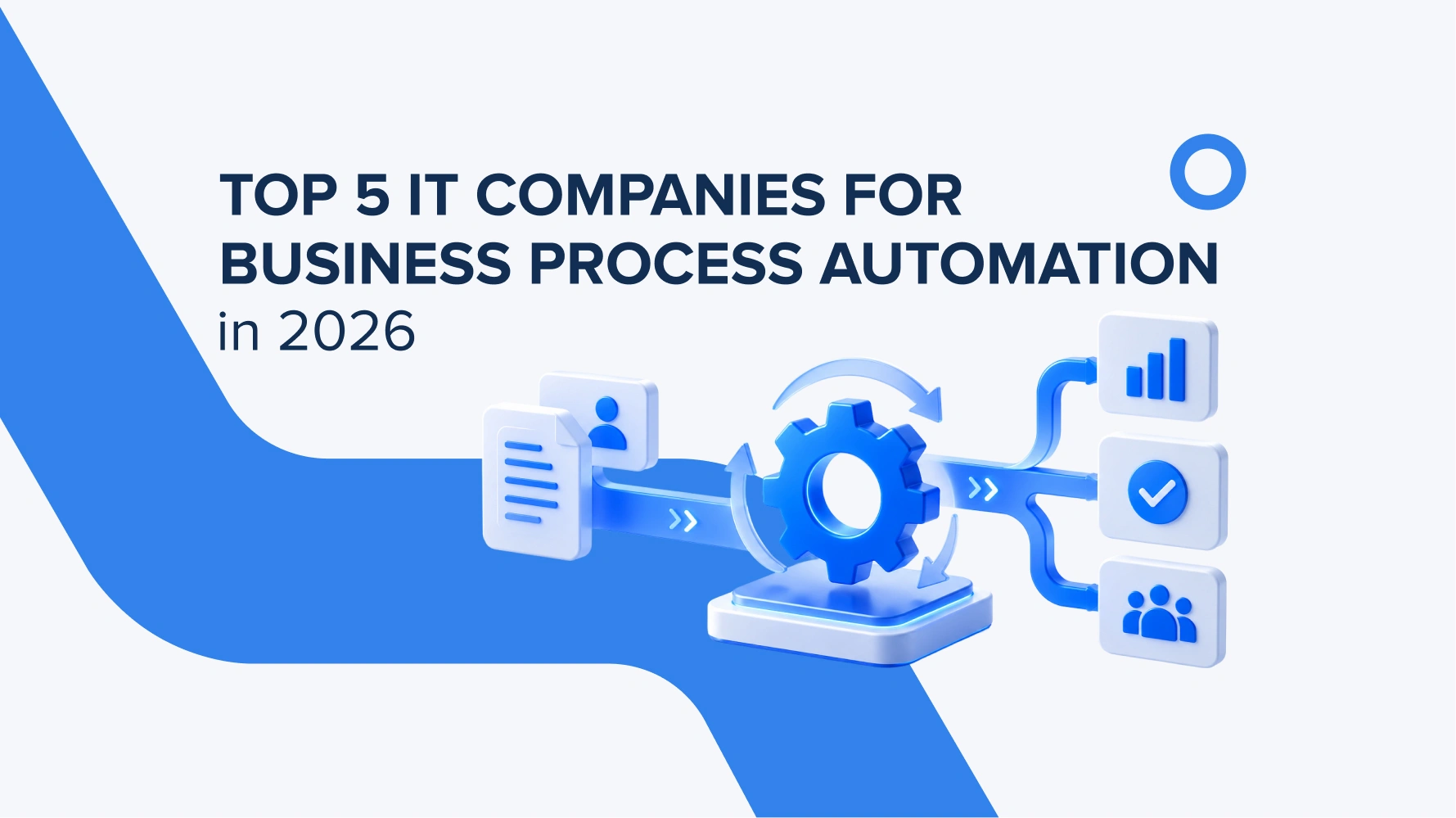
Business process automation helps companies reorganize operational processes, integrate different systems, and use AI where it can create real business value. In this article, we’ll look at the top 5 IT companies that offer different approaches to automation, including RPA, custom development, and AI solutions integration.
What is business process automation?
Business Process Automation (BPA) is a widely used approach in 2026 that automates repetitive business processes with the help of digital systems, AI, and integrations, with very little human involvement. In a wider sense, BPA is about reshaping how the business handles its everyday processes.
Together with its value, there are also thoughts that automation is a slow, team-replacing process. Gartner draws the opposite conclusion. Their research shows that companies with the strongest ROI focused on using automation to make teams more effective rather than smaller. The highest returns were achieved by organizations that invested in new roles, skills, and operational models to work alongside AI.
«Long-term, autonomous business will create more work for humans, not less.» — Helen Poitevin, Distinguished VP Analyst, Gartner.
BPA focuses on replacing routine operations that slow the completion of other important tasks. In fact, it minimizes numerous time-consuming processes – transferring data between systems, document processing, updating statuses, generating invoices, processing requests, or communicating with customers.
BPA automates routine tasks, not expertise, because people should spend their time on work that creates value for the customer, not on transferring data between spreadsheets.
How does BPA work in a real business environment? In most companies, one simple process touches a few internal systems at once – CRM, ERP, accounting, email, messaging apps, and internal databases. Without automation, employees just duplicate information manually.
Imagine a real estate company receiving dozens of leads every day. When a client submits a request for a two-bedroom apartment, the system can automatically analyze their budget and preferences, match them with suitable properties, assign the lead to the right agent, and schedule a viewing. The manual work used to take 20 to 30 minutes is now done in seconds without duplication. That’s the core value BPA brings.
What is the outcome? Faster lead response, fewer manual tasks, and more leads handled without expanding the team at the same rate.
Another thing to keep in mind – automation can take different forms depending on what a business needs to automate. BPA, RPA, and AI are three key approaches, each serving a different purpose. Here’s what they can do.
|
Approach |
How it works |
Typical business use |
Business value |
| BPA (Business Process Automation) | Automates an end-to-end business workflow across systems. | Lead management, sales workflows, order processing. | Reduces operational workload and makes processes more scalable. |
| RPA (Robotic Process Automation) | Automates repetitive, rule-based tasks. | Data entry, invoice processing, report generation. | Saves employees’ time and reduces manual errors. |
| AI Automation | Analyzes information, identifies patterns, and supports or makes decisions. | Lead qualification, document analysis, recommendations, customer support. | Speeds up decision-making and enables more personalized, responsive operations. |
Why is business process automation important in 2026?
In 2026, business processes and workflow automation transform into something deeper than replacing manual work. For every other company (in today’s business environment), BPA becomes a way to scale the business without a corresponding increase in operating costs, speed up customer service, move faster on decisions, and build operations that support growth.
The push toward automation is getting stronger as AI expands what businesses can automate. It allows businesses to automate not only clearly defined actions, but also processes that previously required human intervention. Like analyzing a customer’s request, processing documents, or determining the next step in the workflow.
According to McKinsey, 44% of companies are already scaling AI and automation across the entire organization, improving business intelligence. At the same time, only 37% see a direct impact on EBIT. And that’s where we see the main challenge – technology doesn’t create value, but properly redesigned processes do.
For companies, this comes with several practical advantages:
– Lower operational costs. The team spends less time on repetitive tasks.
– Faster customer response. Requests, inquiries, and transactions can be processed much more quickly.
– Better scalability. The company can increase its volume of operations without proportionally expanding the team.
– Fewer human errors. Automated workflows reduce the number of errors in data and documents.
– More focus on high-value work. Employees can concentrate on customers, strategy, and tasks that require expertise.
How we selected the TOP 5 companies for business process automation
We selected these business process automation companies based on how effectively they help businesses automate and optimize real-world processes. Our evaluation focused on several key factors:
– Business impact. The ability to reduce operational workload, improve efficiency, and support business growth.
– Automation capabilities. The range of processes and workflows the delivered solution can automate.
– AI integration. How effectively AI is used to improve decision-making, personalization, and process efficiency. As well as the overall quality of AI-powered automation implemented in core business processes.
– Scalability. Whether the solution can support businesses as their operations and customer volumes grow.
– Industry experience. Proven expertise in applying automation to specific business needs and workflows showcased in case studies and clients’ feedback.
The final list highlights business automation companies that go beyond automating individual tasks and help businesses build more efficient, scalable operations.
#1 TRIARE — Custom software development and business process automation
TRIARE is a technology partner that helps businesses turn operational challenges into scalable digital solutions. By combining business analysis, custom software development, AI, and integrations, the team builds products around specific business needs and workflows. This approach helps companies improve operational efficiency, streamline processes, and create technology that supports long-term growth.
Working on business process automation software, the TRIARE team starts by analyzing business processes, identifying bottlenecks and repetitive operations, and determining where automation can create the greatest impact.
Based on these findings, the team can combine custom software, AI, integrations, and workflow automation into a solution tailored to the client’s needs. This may mean connecting existing systems, automating repetitive tasks, introducing AI into decision-making workflows, or developing custom software to replace fragmented manual processes.
|
Service |
What TRIARE automates |
Value for client |
Key advantage |
| Business Process Automation | End-to-end workflows, approvals, task routing, notifications, and data flows. | Reduces operational workload and makes processes more scalable. | Automation designed around the client’s existing business logic. |
| AI Automation | Lead qualification, document analysis, recommendations, customer interactions, and decision-support workflows. | Speeds up processes and enables teams to handle more requests. | Combines AI capabilities with custom software and business workflows. |
| RPA & Workflow Automation | Repetitive tasks such as data entry, automated reporting, and information transfer between systems. | Saves employees’ time and reduces manual mistakes. | Connects repetitive tasks into broader automated workflows. |
| System Integrations | Data exchange between CRMs, ERPs, payment systems, websites, API integrations, and other business tools. | Eliminates duplicate work and creates a connected operational environment. | Custom integrations built around the client’s technology stack. |
| Custom Software Development | Digital platforms and internal tools that replace manual or fragmented processes. | Gives businesses greater control, efficiency, and room to scale. | Software is built specifically for the company’s processes and growth plans. |
| Business Analysis & Process Optimization | Identification of bottlenecks, redundant steps, and automation opportunities. | Helps prioritize automation where it can deliver the highest business impact. | Technology decisions are based on business goals, not just available tools. |
This approach allows TRIARE to act as a long-term technology partner: delivering software and helping businesses identify where technology can improve operations, and then turning those opportunities into scalable solutions.

#2 UiPath — Enterprise RPA and intelligent automation
UiPath is a well-known platform for business process automation at the enterprise level. It is based on RPA, but today the platform integrates robots, AI, document management, APIs, and enterprise systems.
Going for UiPath services, businesses can automate separate routine operations as well as the whole process chains – document processing, data transfer between systems, approvals, decision-making, and interaction between employees and automated systems.
The platform is a solid option for mid- and large businesses with a large number of repetitive tasks, complex workflows, numerous corporate systems, or legacy infrastructure.
|
Capability |
What UiPath does |
Business value |
Key advantage |
| RPA | Automates repetitive tasks such as data entry, invoice processing, and system-to-system data transfer. | Reduces manual work and possible mistakes. | Works across modern and legacy applications. |
| AI Automation | Adds AI to workflows for document understanding, decision-making, and handling more complex tasks. | Expands automation beyond predictable processes. | Combines AI with RPA in the same environment. |
| Process Orchestration | Coordinates people, robots, AI agents, and systems across end-to-end workflows. | Reduces bottlenecks and improves process visibility. | Manages entire processes, not isolated tasks only. |
| System Integration | Connects enterprise applications, APIs, and data sources. | Eliminates disconnected workflows and duplicate data entry. | Supports both API and UI-based automation. |
| Document Processing | Extracts and processes information from business documents. | Speeds up document-heavy operations and reduces manual data processing. | Uses AI to work with unstructured information. |
| Automation Governance | Provides centralized access controls, audit trails, monitoring, and oversight. | Helps enterprises scale automation while maintaining control. | Designed for large, regulated environments. |

#3 Clockwise Software — Custom automation and software development
Clockwise Software brings together custom software development with business process automation services and AI solutions. The company automates workflows, data processing, decision-making, as well as integration between different systems. They are known for delivering solutions tailored to each client’s needs and built around specific business goals.
The team works on both separate task automation and complex workflows that cover several systems and process stages. Their approach fits best for companies for which standard automation platforms are not enough, so they are looking for a more comprehensive and reliable solution.
| Area | What it automates | Business value | Key advantage |
| AI Automation | Data entry, document processing, communication, routing, and approvals. | Reduces manual work and operational costs. | Integrates AI directly into business workflows. |
| Workflow Automation | Repetitive tasks and multi-step business workflows. | Speeds up daily operations. | Automation is tailored to specific business processes. |
| Custom ERP | Finance, HR, supply chain, and order management. | Centralizes data and streamlines operations. | Custom-built around the company’s requirements. |
| API Integration | Data exchange between CRM, ERP, internal & third-party systems. | Removes duplicate data entry and disconnected workflows. | Adapts to the client’s current tech stack. |
| Predictive Analytics | Demand, workload, and possible risk forecasting. | Speeds up data-driven decision-making. | Turns operational data into actionable insights. |

#4 Velvetech — Automation, AI, and enterprise software solutions
Velvetech offers business process automation services in 2026 and specializes in AI and enterprise solutions development. Their service set specifically fits companies with complex operational needs and large data volumes they operate with every day.
The company helps businesses automate repetitive tasks, integrate external systems, and use AI to optimize workflows. To address this, the team combines cutting-edge technology with customization to fit the client’s processes and infrastructure.
|
Area |
What Velvetech automates |
Business value |
Key advantage |
| Business Process Automation | Repetitive tasks, workflows, and data flows. | Optimizes operational efficiency and reduces workload. | Solutions tailored to specific business processes. |
| AI Solutions | Data analysis, decision support, customer interactions, and intelligent workflows. | Speeds up operations and supports better decisions. | AI integrated into existing business workflows. |
| RPA | Rule-based tasks, data entry, document processing, and system operations. | Saves employees’ time. | Suitable for repetitive, high-volume processes. |
| System Integration | Data exchange between enterprise applications and platforms. | Connects fragmented systems and eliminates duplicate work. | Integrates automation with existing IT infrastructure. |
| Enterprise Software | Complex operational processes and internal business workflows. | Improves scalability and process control. | Custom software designed for enterprise requirements. |

#5 Computools — Custom software development and business process automation
Computools is an IT company for business process automation with a great focus on clients’ business outcomes after implementing automation. The team helps companies go digital in every process and internal workflow with the help of custom software development, AI, data engineering, and system integrations. In general, the company specializes in optimizing operations, reducing manual processes, and creating scalable solutions tailored to the client’s business logic.
|
Area |
What it automates |
Business value |
Key advantage |
| Business Process Automation | End-to-end workflows, task routing, and operational processes. | Reduces operational overhead and improves efficiency. | Workflow automation customized to your business. |
| AI Solutions | Document analysis, customer requests, forecasting, and decision support. | Accelerates processes and enables data-driven decisions. | AI embedded into enterprise operations. |
| Custom Software | Internal platforms, ERP, CRM, and business management systems. | Replaces fragmented tools with unified digital solutions. | Software designed around specific business requirements. |
| System Integration | CRM, ERP, cloud platforms, APIs, and third-party services. | Creates seamless data flow across business systems. | Eliminates duplicate data entry and disconnected processes. |
| Data & Analytics | Business intelligence, reporting, and operational insights. | Improves visibility into performance and supports strategic planning. | Turns business data into actionable insights. |

What should a business know before ordering process automation? Insights from TRIARE experts.
Great results reach those companies that analyze their business first and only after this choose technologies and approaches to add automation where it’s needed. At TRIARE, we see the whole process as collecting the information base for the right development decisions.
Automation delivers the greatest value when it solves specific business challenges: it reduces operating costs, speeds up the team’s work, and creates processes that scale easily along with the company. Thus, do the following.
Automate the process itself, not excessive steps
If some workflow contains unnecessary steps, duplication, or manual approvals, automation will only accelerate these issues. You should start by identifying bottlenecks and optimizing the workflow.
Identify the processes with the highest ROI
Not all workflows need to be automated right away. The best candidates for improvement are those processes that:
– occur daily;
– involve multiple systems or departments;
– require a significant amount of manual time;
– directly impact the customer experience or revenue.
Make sure your systems can work together
CRM, ERP, accounting, payment services, and internal platforms must exchange data without moving data around manually. That is what determines the success of automation more than the choice of a single tool in most cases.
Plan for scalability from day one
Automation should always support future business growth. Custom workflows and modular architecture help you scale the solution without replacing the whole system.
Conclusion
The right automation partner should do more than introduce new technology. The real value comes from understanding how the business operates and turning that understanding into solutions that improve efficiency today while remaining flexible to support future growth.
Ready to automate your business processes? TRIARE can help you identify processes with the highest automation potential and turn them into practical, scalable digital solutions. Contact our team to discuss your workflow and find the right automation approach for your business.