How AI Is Transforming Software Development in 2026
In this article, you’ll find out how AI is transforming software development in 2026. Which development stages can already be automated, how AI coding assistants are impacting engineers’ work, and what benefits this brings to businesses. We’ll also explain why human oversight remains critically important and how TRIARE uses AI in custom software development.
What does AI software development mean in 2026?
Artificial intelligence is steadily integrated into the entire software development cycle. Thus, AI software development in 2026 means the use of smart technologies for various technical tasks – requirements definition, AI coding, testing, debugging, documentation, and deployment.
We see a transformation from AI-assisted code writing to AI-assisted software engineering. This means that developers and teams can use AI to tackle real engineering problems, not just write features. For example, they set a specific task, provide the necessary context and constraints, and the AI will then perform several related actions. Whatever you need – modify the code, create tests, or prepare documentation. The one thing that hasn’t changed is that it’s still up to the human to verify the results.
The impact on the results the AI generates shows that smart technologies continue to progress, and now they can bring more accurate and measurable benefits compared to previous years. Such a positive dynamic is also proven by the Stanford AI Index Report 2025. It says:
“It’s a sharp increase in AI performance on SWE-bench, a benchmark that tests models’ ability to solve real-world software problems. The performance improved from 4.4% of tasks solved in 2023 to 71.7% in 2024.”
As part of AI coding tools, teams actively use AI agents for software development that step into the development process in 2026. Unlike a basic AI coding assistant, an agent can carry out a series of actions to achieve a specific goal, rather than simply responding to a single request. It’s a clear sign that modern AI development is gradually shifting from a model where “humans write code, and AI assists” to one where AI can handle part of the entire workflow under an engineer’s supervision.
At the same time, it’s important to remember that AI doesn’t replace software engineering. It simplifies engineers’ tasks and handles routine work, so teams build software faster and focus on architecture, product solutions, results validation, security, and the integration of systems with real-world business processes.
All in all, in 2026, businesses will need to be more deliberate about which parts of development they hand over to AI. What data and access to grant it, and at which stages human oversight must be maintained.
How is AI changing the traditional software development lifecycle?
AI doesn’t fully replace the traditional software development lifecycle (SDLC) stages. It only brings changes to specific steps and the way teams work now. Here’s how it looks.
|
SDLC stage |
How AI is changing the process |
Business impact |
| Planning & requirements | AI analyzes requirements, helps structure user stories and acceptance criteria, and identifies inconsistencies in documentation. | Faster transition from a business idea to a structured development plan. |
| Design & architecture | AI helps compare technical approaches, draft API documentation, and analyze trade-offs between different solutions. | Faster technical evaluation while engineers retain responsibility for architectural decisions. |
| Development | AI generates code, explains existing code, supports refactoring, and can perform sequences of development tasks through AI agents. | Less time spent on repetitive coding and faster implementation of individual features. |
| Testing | AI generates unit tests, suggests edge cases, analyzes errors, and helps identify potential defects. | More automated testing without requiring a proportional increase in manual testing effort. |
| Deployment & monitoring | AI analyzes logs, detects anomalies, and helps investigate post-release issues, while critical production actions remain under human control. | Faster issue detection without giving AI unrestricted access to production systems. |
| Maintenance | AI explains legacy code, assists with debugging and refactoring, generates documentation, and helps update existing components. | Easier maintenance of older systems and faster onboarding of developers to unfamiliar codebases. |
Don’t think of AI as a standalone player in the entire SDLC. For example, 76% of developers do not plan to use AI for deployment and monitoring only, and 69% do not plan to use it for project planning. This shows that the higher the risk, the more human involvement is needed.
Another important change is the way effort shifts across the process. DORA Report 2026 notes that AI can reduce the time spent on initial code generation, but some of the time saved is redirected to auditing and verification, checking and auditing the AI results.
Which parts of software development can AI automate?
For now, AI is capable of automating whole groups of repetitive tasks during the development process. At the same time, the level of automation depends on the task itself: the clearer the task and the easier it is to check, the more AI can take on. In the list below, there are tasks that AI can automate within software development.
Code generation and its further modification
The developer describes the functionality AI should generate in simple words and short explanations. Then the AI processes the inquiry and does specific actions – creates an initial implementation, modifies existing code, refactors it, or generates repetitive parts of the program.
However, you can’t assume AI-generated code is correct. The 2025 Stack Overflow survey states that:
“66% of developers cited situations where the result is “almost correct, but not quite” as the biggest problem with AI solutions, while 45% noted that debugging AI-generated code can take longer.”
Tests generation
AI can create unit tests, suggest additional test scenarios, and identify edge cases – unusual cases that are easy to miss during manual testing. This doesn’t mean that AI replaces QA. It’s worth it because it lets the team create a larger set of automated tests faster.
Mistake search and fixing
AI can analyze error messages, system logs, stack traces, and related code to identify the possible cause of a problem and suggest fixes. Rather than manually trying to figure out a piece of code, a developer can ask the AI to explain its logic, dependencies, and possible pitfalls.
And as we said before, the final verification is always on the engineer’s side. The fix AI suggested must be tested and verified for compliance with business logic.
Code checking and refactoring
AI can find duplicate code, identify potential issues, suggest simpler implementations, and assist with refactoring.
Technical documentation writing
AI automates a significant part of routine work related to technical documentation. It explains functions and classes, creates API descriptions, and summarizes existing code. For businesses, matters even more in large projects, where documentation can quickly fall out of date. AI helps keep it in sync with the code, but the technical details still need to be reviewed by the team.
Dealing with legacy code
Legacy code is code that was created a few years ago and has become more complex at the same tempo as the product grows. To address this, AI can explain the logic behind an unfamiliar module, trace dependencies, identify duplicates, suggest refactoring, or help a developer understand how a particular component relates to other parts of the system. This way, an AI-powered code assistant transforms legacy code into updated one.
Technical analysis & Research
AI significantly reduces research time as it processes tons of information much faster than humans. Developers use it to compare technologies, explain unfamiliar concepts, analyze documentation, and explore possible implementation approaches.
How do AI coding assistants help developers write code faster?
First and foremost, AI coding assistants support comes when teams are loaded with routine tasks while writing code, researching information, and working on existing code. They easily take on these types of tasks as they use algorithms that allow them to process data quickly and efficiently. In this case, AI development tools help teams allocate working time more effectively, with the possibility to focus on complex solutions and results checking.
The greatest practical value of AI coding assistants lies in several areas:
– AI creates code snippets based on a description, including boilerplate and repetitive sections.
– AI explains complex logic, identifies problem areas, and assists with refactoring.
– It can generate unit tests and suggest additional test scenarios.
– It analyzes errors, logs, and stack traces and suggests possible fixes.
– It helps you quickly navigate documentation, libraries, and unfamiliar technologies.
How is TRIARE using AI to improve custom software development workflows?
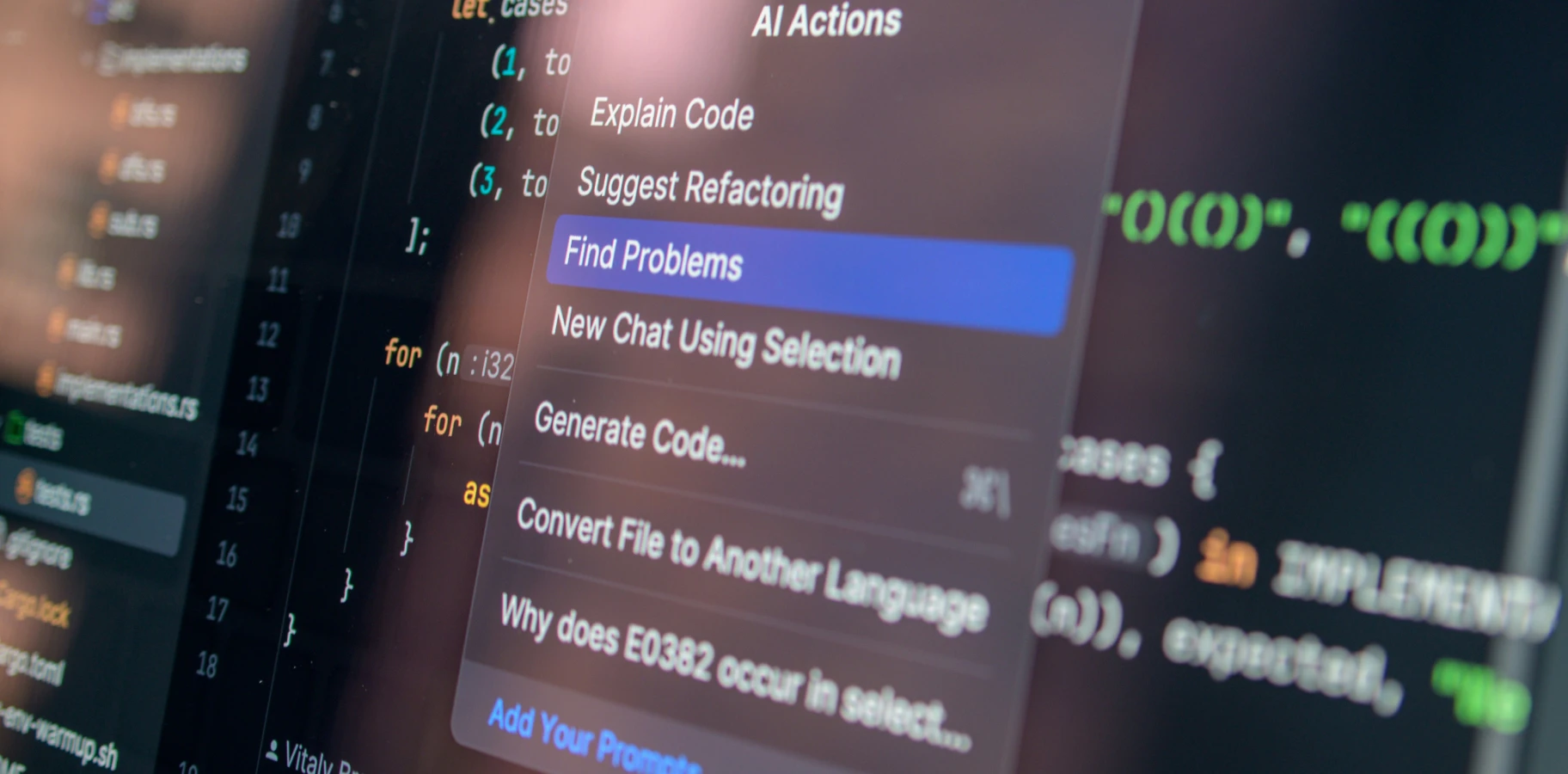
At TRIARE, we leverage AI as part of software development to assist our experts in specific tasks. We put it into a process at the very beginning – the discovery phase. At this stage, AI helps validate ideas, define use cases, and structure requirements, and then uses it for code generation, testing, debugging, refactoring, and documentation.
In 2026, we move from a standard approach to a more complex and smarter one:
“Team defines the product logic → AI generates code → automated testing → verification → adjusting.”
And what’s more important – the developers stay around as an integral part of the process. They set the context, monitor the results, and make critical technical decisions. Quick performance and a deeper view of technical product parts are the strongest options of AI for coding, but critical thinking and creativity are still human nature.
In practice, AI supports the TRIARE team with:
– test product hypotheses and use cases more quickly, even before development begins;
– generate boilerplate code, UI components, and API clients;
– automate the creation of tests and documentation;
– find bugs and assist with debugging and refactoring;
– work with legacy code and understand the existing architecture more quickly;
– use AI agents to perform sequential technical tasks.
These align with TRIARE’s overall approach: the team handles the entire development cycle (from discovery to release and support), using AI in software development as part of a modern technical process.
Meanwhile, TRIARE doesn’t give the AI unlimited control over the product. For AI solutions, the team first defines the use case, risk level, and success criteria, and then establishes appropriate rules, checks, access controls, and fallback scenarios. For production systems, the team also monitors the AI’s behavior, the data used, tool calls, latency, and the quality of generated results.

How does AI change MVP development for startups?
The obvious fact is that AI speeds up the MVP go-to-market process. There is no need to spend months on idea validation and its realization as it was before. Today, AI supports MVPs with requirements analysis, prototyping, code generation, testing, and documentation, so the team can get through the first iterations more quickly.
A METR study conducted in February–April 2026 surveyed 349 technical professionals, including 87 software engineers. Participants reported the following fact:
“AI delivered a 1.4–2x increase in the median value of engineers’ work.”
At the same time, METR emphasizes that this is a self-assessment, so the figure should not be interpreted as a proven 1.4- to 2-fold increase in productivity.
Another notable fact is that AI makes MVP experiments cheaper and faster. Those that were previously delayed due to high development costs. For example, a team can more quickly test several functionality options, create an internal prototype, or test an additional hypothesis even before full-scale development begins.
Therefore, AI is widely used to move MVP development more quickly through the hypothesis, prototype, testing, feedback collection, and iteration cycle. At the same time, the architecture, business logic, security, and product readiness criteria are still under the engineering team’s control.
What are the benefits of AI-assisted software development for businesses?
The value of AI-assisted software development lies in how deeply it involves into the development process, understands context, and generates code based on business logic and a prescribed set of rules and requirements for software. In a wider sense, businesses get the following benefits with AI development.
|
Business benefit |
How AI helps |
Business impact |
| Faster development | Generates code, tests, documentation, and assists with debugging. | Features and product iterations can be delivered faster. |
| Lower cost of repetitive work | Automates routine and time-consuming technical tasks. | Developers spend less time on manual implementation. |
| Faster validation of ideas | Helps create prototypes, test scenarios, and implement changes faster. | Businesses can validate product hypotheses earlier and with less development effort. |
| More efficient use of engineering expertise | Handles part of the execution while developers focus on architecture, business logic, and complex decisions. | Senior engineering expertise can be focused on higher-value work. |
| Easier legacy system maintenance | Analyzes existing code, explains dependencies, and assists with refactoring. | Businesses can extend existing software without immediately rebuilding it from scratch. |
| Greater development capacity | AI allows developers to complete more technical tasks within the same workflow. | Teams can increase development output without proportionally increasing manual effort. |
| Faster testing and quality checks | Generates tests and identifies potential issues earlier in development. | Problems can be detected earlier, reducing the cost of fixing them later. |
Why does TRIARE keep architecture, security, and business logic under human control?
The TRIARE team uses AI for analysis and data generation, but the product’s architecture, security, and business logic stay under engineers’ control. The reason is simple – AI is not responsible for the consequences of its technical decisions. It can recommend architecture variants, generate code, or find essential data at the research stage, but is not familiar with all the business constraints, regulatory requirements, long-term product goals, or the cost of a mistake.
The TRIARE approach is AI under the control of an engineer. AI takes on more of the routine and technical work, while humans stay in control of decisions that could impact safety, system stability, or business results.
Here’s why we keep architecture, security, and business logic fully under the TRIARE experts’ control.
Architecture
AI can suggest several technical approaches, but the choice between them depends on the product context: expected load, integrations, budget, scalability, and support requirements. The wrong decision can create technical debt that will be costly to fix after launch.
Security
AI-generated code requires verification just as much as code written by humans. This is particularly important because AI can generate code with known security weaknesses or misuse libraries and APIs.
Business logic
AI can correctly implement a technical task while still misunderstanding how the business process itself is supposed to work. For example, a rule for calculating prices, commissions, or eligibility may have exceptions that aren’t included in a brief task description. That’s why the business context cannot be fully delegated to the model.

Will AI replace software developers or change their role?
Absolutely not. Software, web, or mobile development will always rely on human thinking and non-obvious decisions only humans can make. Seeing how AI has evolved so far and how fast it learns from its own mistakes, it may seem that, in the future, developers can be fully replaced by smart technologies. In reality, it’s not quite right.
AI doesn’t replace software developers; rather, it changes the way they work. Some tasks that used to be done manually are already automated, but the engineer’s role is shifting from writing every line of code to defining problems, working on architecture, verifying AI-generated output, and ensuring quality control.
It’s not a battle between AI and developers. The future is about teams working with AI, not against it. A developer who knows how to properly define tasks for AI, provide it with the necessary context, verify the results, and use automation without losing engineering control will have significantly more opportunities.
Why is TRIARE the right partner for AI-powered software development?
At TRIARE, we combine AI-assisted software development with proven approaches that support our team during complex software development. We leverage AI code generation, testing, documentation creation, debugging, and comprehensive data analysis. But there’s more to it – we don’t rely on AI when working on architecture, security, business logic, and critical production solutions. This work is still on the human side.
Therefore, the TRIARE team helps businesses with:
– Determine where AI is truly needed for your product. We’ll analyze your business processes inside and out and identify tasks where AI can reduce manual work, speed up operations, or improve the user experience.
– Build an AI-powered product from concept to production. We’ll help you navigate the entire cycle: define requirements, select technologies for further development, testing, launch, and ongoing support.
– Accelerate development without losing engineering control. We’ll use AI to generate code, tests, documentation, debugging, and other repetitive tasks, while leaving key technical decisions to the engineers. That’s the core approach we stand on.
– Integrate AI into existing software. If your business already has a system in place, we’ll help add AI capabilities without having to completely rebuild the product.
– Protect business data and critical logic. We’ll determine which data and operations can be accessible to AI, and which must be under the team’s control.
– Build a scalable solution. We’ll design AI functionality with future workload, infrastructure costs, integrations, and product development in mind.
– Minimize AI technical risks. We’ll verify AI-generated code and model results through testing, code reviews, and human validation before deploying them in production.
Conclusion
AI doesn’t replace software engineering as we used to know it. Instead, smart technology changes the way software is built. Companies that use AI to integrate it into a well-thought-out development process while maintaining human control over architecture, security, and business decisions will reap the greatest benefits.